My journey is complete. No, not complete, but somehow feeling full circle in the way that I was needing yesterday.
Yesterday the smoke returned. August in the Pacific Northwest is not the August I floated carefree and lazily through as a child. The excitement of summer, those few precious months of brilliant sunshine and blue skies and perfect temperatures for swimming and lemonade stands and blackberry picking….like so many things in my life that have trickled through my fingertips, summer too, seems to have changed forever, water soaking down into sand never to be seen again.
Under smokey skies, the air stifling hot and orange with the acrid smell of far off fires, forests burning, I went to the road end to swim. I had spent the day, another day, with children. This week they learned to sew. I taught little boys and girls to sew.
These children are lucky.
They are coming to art camp, well fed, rested, loved, eager and curious. And we bring out recycled and repurposed materials and teach new skills with wire and thread and tape and they go wild. They are learning a little bit about renewable and limited resources. They are learning to share, and collaborate and make mistakes, using recycled corks and cardboard boxes and bottle caps. I love them all. Like my swims, they are full of surprises and remind me to look closely and pay attention or I’ll miss the important lessons they are teaching me just by observation alone.
My job is easy and hard.I’m tired when I get home, but I am full. Full like a moon snail.
Children have no secrets. What you see is what you get. They live for now, this moment, seeking out whatever is directly before them, burrowing down into sand when the tide recedes. They grow just as they should, with good air and water and a rich environment full of plenty of food.
Spending days with children has helped me reconnect with myself, much like the sea.
My late afternoon swim was through clear water, speckled with brown flecks. The air was hot, the sky a brownish haze over the Olympics. I knew I’d be pulling extra smoke into my lungs but I was so desperate to swim I didn’t care.
My heart was full from a day with children, and heavy thinking about our hot planet and what the future may bring.
I wanted to go home, smoke be damned. I swam south, the water smooth on the surface, rocks still below me. This is where I needed to be.
I tried to focus on the task at hand—breathing. The bubbles burst forth, I sucked in breathes, one by one. I swam and I thought about seals. And crabs. Where were they? How are they adapting to this changing climate? Will they survive? Will we? A blizzard of brown flecks surrounded me. I kept swimming, letting the water hold me again.
I refocused on the world below me, reminding myself to just look. See what I could see right below me. Rocks and shells appeared, hazy and still. Waiting for nothing. Just being—rocks and shells. A strange and familiar sight caught my eye. Yes. A moon snail shell below me. I pushed the water before me, judged the depth, unhooked my float and dove down to pluck the broken spiral from the sea floor.
It has been a few months since I last found a moon snail shell. As I tucked it carefully into my float, I smiled to myself. I needed a sign. Something to trust, believe in. Hope for our planet. Something, anything to assure me that somehow we will make it through.
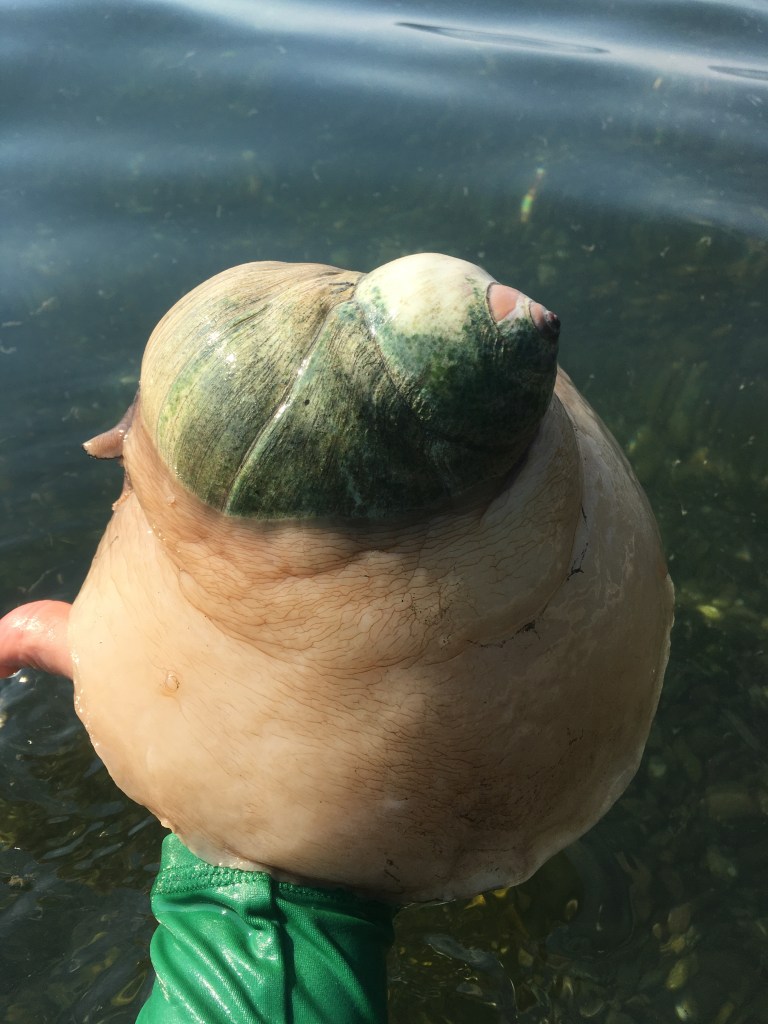
I kept swimming. Below me a blurry white shape caught my eye. Could it be? Yes. On instinct I unhooked my float again, and dove down again, surfacing with a massive live moon snail. The snail itself bulged from below its shell, a massive white body, firm but soft. I carefully perched it upon my forearm.
A year and a half of open water swimming and I was holding a live snail for the very first time. The weight of its body was reassuring. If this snail could survive, surely we can too. As it rested heavy on my forearm, it’s foot slowly wrapped itself down around my arm. The weight of it slowed my breathing, stalled my thoughts.
I studied this voracious eater, looked for its eyes, marveled at its size and wondered about its age. I believe these creatures can live up to 15 or so years. By the looks of it, it could be the age of my youngest son.
I felt a wave of hope and joy and love course through me. We must all adapt, and grow and change.
Surely we will find a way. Surely we will save the moon snails. We must.
All is not lost, but we are out of time. As I carefully returned the moon snail to the sea floor, I let go of something.
To go forward we have to let go. Over and over again. Like swimming. One breath in, one breath out.
And I have my neighbor, Dave, to thank for it. And the shuttering of the pools last year due to the pandemic also played a part.
This whole open water swimming thing I’ve embraced is entirely his fault, as is my designation as a fat salmon. Over a year ago Dave invited me to try a swim in the Salish Sea, and here I am over a year later, utterly waterlogged, running around coated in salt and encouraging anyone willing to listen and able to tread water to get in. Open water swimming in the Salish Sea has changed me. So did the pandemic, just like everyone else in a million small and huge ways. And my life.
On August 1st, at 11:00am, I stood waist deep in silky green water next to Dave at the landing. Our “race” was blessed with a good luck omen—as I surfaced from my initial dive under to get acclimated a surprise spotting of a billowy whitish pink nudibranch took my breath away, filling me with awe and wonder. It’s delicate body undulated just below the surface, wrapped up amidst a stringy nest of light green seaweed, twisting and slowly writhing easily through the green water.
This was going to be a good swim.
The beauty of this rare creature took my mind completely off of the cold that initially shook my resolve to do this swim, and once Dave pressed start on his iPhone timer and tucked it quickly back in his swim float, we struck south steadily through fuzzy green water.
I had arrived tired and a little cold to the landing, set on accomplishing this swim, with a healthy dose of peer pressure nudging me to get in and get it done.
With sleepy eyes, an empty stomach and only strong coffee to start my engine, and over five hours of performances from the day prior, I was not in peak shape for this. And it was morning time—I’ve become a late afternoon swimmer since the pandemic took away the pool and I took to the open water instead.
With the first strokes the caffeine kicked in, happiness filled me and just as I settled into the rhythm of the swim, we hit a solid wall of tomato soup-colored water. All visibility disappeared and I fought the urge to bail out, unnerved by the brown water. For most of the 1.2 miles of our officially unofficial Fat Salmon Swim (traditionally held on Lake Washington), we swam through some of the brownest water I had ever seen. To fight off nerves and reassure myself that all was fine, I did frequent checks for Dave’s buoy, and was calmed and determined to keep going, watching him pull through the water seemingly nonplussed and utterly relaxed.
Pressure to keep up and keep swimming without stopping helped me continue on, aware that this was timed. I didn’t want to slow Dave down too much and I knew I could swim this distance. Last summer I had gone twice this distance and even though my swims this summer have been shorter, this was a distance I am used to.
My stubborn “finish what you start” mentality was going to help me get through this.
Fortunately I knew Dave was in no hurry, and as I predicted, he graciously stayed at my pace the whole time, tacking a solid twenty-plus minutes onto his best time because he’s that kind of a guy. Like me, Dave swims because he loves to swim and his competitions seem to be entirely with himself. Still swimming year round in only his Speedo and a pair of goggles, he has accomplished a mighty feat year after year. Speed be damned. Who cares. He’s in it to feel alive, get cold, and swim through time. As am I.
And Speedo’s? Who needs them? Like a little boy caught with his hand in the cookie jar, Dave sheepishly and proudly admitted he sometimes swims naked alone, stuffing his bottoms into his swim buoy. Go Dave, I say.
On our chosen “race day”, we were down to the wire, as they say, waiting until the second to last day to compete. After swimming our chosen distance (choice of 1.2 or 3.2 miles), tracking our time as accurately as possible and sending in a photo of our Fat Salmon swim, we marked our participation and would be able to wear our yet-to-arrive T-shirts proudly.
I plan to wear mine with the same pride as an Olympian sporting a gold medal. I’m no Olympic athlete by any stretch—far, far, far from it—but I share a steadfast commitment to the art of swimming and blinding drive to capture the experiences of the Salish Sea and our need to protect it that rivals the dedication of any Olympian to her or his chosen sport. And as we recently watched a star Olympian just say no, Ms. Biles, whom chose mental health over all else, I will also listen inward to what feels right. If the swim doesn’t feel right, if I’m chilled or feeling unnerved by the water, I too, will get out. There is always tomorrow.
Very unlike an Olympic athlete I have almost no competitive muscle left in my body, and at my age am truly just glad that my body is still mostly cooperating with my physical needs, namely swimming and walking. I had to say goodbye to running a couple years ago, but I never liked it much anyway. Those days are over. Phew.
For the record, I have never in my life competed in any swimming race, competition or event. Ever. And so again, open water swimming provided me with yet another first.
At the half-way mark we paused to catch our breath. I whooped with relief. We battled an outgoing tide on the first leg south, and it had indeed felt like a long half mile. The return trip took us under half the time, as we rode north with the current, the finish line waiting for us.
I tried swimming faster for the last few yards, so pleased to have arrived. Dave waited ahead in the shallows, timer in hand.
“How’d we do?” I asked.
“One hour and 12 seconds,” Dave replied with a smile.
I smiled back.
Tomato soup, nudibranch and all, it was a very special swim.
Maybe next year I’ll try it again. I know Dave will be game, and if the water is clearer perhaps we’ll spot some fat salmon swimming home.
My time might improve or maybe not. Either way, it’ll be a fine time.
If I could offer one thing to children everywhere, after the obvious necessities including unconditional love and education, it would be swim lessons. Drownings happen all the time, and in some countries are very common. Swimming lessons would save countless lives around the world, and especially children whom so often are the victims. Beyond the obvious life saving of swim lessons, swim lessons are life enhancing and are the gateway to a lifetime of enjoyment in and on the water.
Access to water and childhood swimming lessons and the gift of time to go swimming are all things I have been privileged to have in my life.
I took so much for granted as a kid—plenty of food, a warm bed, a good education, healthcare, access to saltwater and beaches and trails and wide open summers spent in or on the waters of the Salish Sea.
My comfort level in the water is nearly matched by my comfort on the water, be it row boat or sail boat, power boat or ferry. I am convinced I breathe more fully, lower my heart rate and may even extend my life’s trajectory with every trip to the water, be it sea or lake, river or ocean.
This comfort with the water came to me not by accident, but because I was taught how to swim at an early age. For kids growing up on an island, this island, swimming lessons were a given. In elementary school, bus loads of kids were transported to the one public pool to learn how to not drown. We learned CPR on creepy life size dolls, puddy-colored rubber lips and no legs. We learned how to blow bubbles and bob at the edge of the pool, we learned to dive in head first—from kneeling, then standing.
The changing room was always sickly damp and the dark cement walls sweat constantly. It reeked of chlorine and wet bathing suits—but we loved it.
I can’t remember clearly not knowing how to swim. I do remember trying synchronized swimming class once—I didn’t last long. It felt counterintuitive to swimming’s joyful magic, like wrestling water or fighting air in an attempt to overcome the water. While other girls tried to defy gravity and kick their way out of the water, shooting their slender legs and torsos out of the water and pointing toes like lost ballerinas, I just wanted to dive down under and sprout gills.
I still want to sprout gills. Diving remains my favorite way to enter any body of water, because to me the whole point is to get down deep. The butterfly stroke still eludes me to this day, beyond exhausting to just watch, it looks awkward and looks like a fight with water. Perhaps I’m just looking for excuses, but that stroke remains the only one I have no interest in learning or doing.
Tonight I learned that a classmate of ours just died suddenly at home. She was just 47 and a mother just like me. I didn’t know her very well, but I remember her in school. I think the last time I saw her was probably 30 years ago. Turns out she lived not far from me, a few towns away, an hours drive, and worked saving lives and fighting fires—the first female firefighter/EMT in a sizable town nearby.
Tonight with this news in hand and heart, my thoughts nudge and jostle about like waves on the beach, pushing the flotsam out of the way, beaching piles of thoughts and reflections on the fragility of life and how despite all our efforts, we humans really don’t know much after all.
I am sad for my classmate’s family, her child, her friends and colleagues. She was too young to die. Dying is supposed to happen when we are old, yet again I am reminded with the force like a tsunami that life —and death—doesn’t work that way. Life goes by fast. Rules and plans and expectations and hearts are broken all the time. It just is. No one is to blame. Again I find myself desperate to not waste time and keep doing what I love every day. Stay open, love fully, and expand my understanding of the world by meeting new people, asking questions, making new friends.
What better way than in the water.
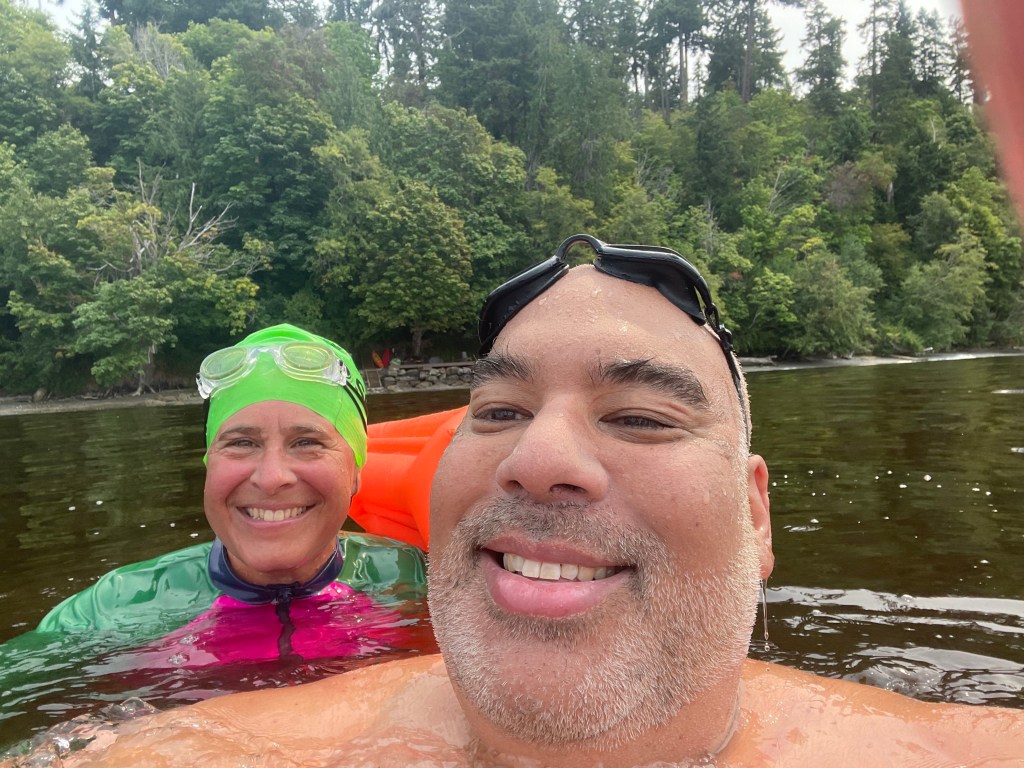
A few days ago I went on another swimming adventure—to Lake Washington. As I wiped sleep from my eyes and felt my morning coffee buzz through my veins I pulled out of my sister’s driveway before 7 am to make a half hour trek to meet a stranger for a swim.
I was tired and giddy, acting on my intuition and riding the wave of my year of swimming and my swim stories that had brought me to this moment. This fellow swimmer, Tom, grew to know me— sharing his thoughts and kindly catching my typos—here, in this blog.
A few other swimmers met up with us at the parking lot beside Lake Washington, swim buoys, looks of ease and friendly smiles upon them. They too, were in on the secret—the joy and magic that is open water swimming. After introductions, we all stood around chatting about swimming, past swims, competitions, future swim goals, favorite swim spots and the open water swim community in and around the Salish Sea. Each person came with different reasons, but we are were held together by a shared love of swimming for swimming’s sake.
What stood out to me was the peace I felt among these kindred spirits. These strangers trusted me, a stranger, to come along, and I trusted them to not lead me astray. We stood beside the Mother, the lake. She was watching over all of us. She would hold all of us up. We trusted her.
To the south of us Mt. Rainier rose up in a white haze, and immediately before us waited a huge expanse of rippled fresh water nestled in the middle of the humming city of Seattle. The early morning sun burned down and with the first step into the warm, clear water, I fell in love with water, again.
I listened in as the four swimmers mapped out a loose route from shore. Moments later I stepped in to the bath water warm lake and swam south in calm water flecked with tiny lake confetti and ringed by an entire city, with humming highways and roads and miles upon miles of people.
Tom asked if I could see Mt. Rainier from where I usually swim, and I said,
“Oh no. I see the Olympics.”
Tom smiled.
“Oh good. Then that’s something new for you to see—sorry you are “slumming” it here in the middle of the city on this swim.” He joked.
We looked out across the blue water.
“Oh, no, it’s all so beautiful.” I replied. I felt the energy of the city, people going to work and travel and stores. The energy of this city hovering right at the edges of this enormous lake.
The lake was beautiful. And the hum of the city faded away as we made our way along the shore. As we went deeper into the lake I struggled to keep my bearings and struggled to find a spot to sight on. No longer able to spot the bottom, with nothing below me to focus on, I kept abreast of Tom’s buoy to keep myself on track, as the disorientation of swimming in a new spot, and huge lake (which also decreased my buoyancy) was a little overwhelming.
A glimmer of anxiety set in, and I stopped frequently to reorient and slow my breathing.
I knew I was in safe hands swimming with Tom, and had corresponded enough to know that he was an experienced swimmer familiar with this location. In hindsight I realize I put a lot of trust in him and myself—our common ground was our shared love of open water swimming. I trusted that the rest would fall into place as it should.
Our three swim buddies quickly out swam us by a long shot, leaving Tom and me behind, to honor our own pace. We paused and he pointed out the way the Willow trees along the shoreline reached down towards the lake, hanging perfectly parallel a few feet above the lake water, appearing as if some giant kept them trimmed to hang just so.
At our turnaround spot we brought our heads up and out of the water, to talk and reflect on why we swim, sharing stories and musings on this shared passion.
I recalled a visit years ago to my aunt and uncle’s apartment on this lake. They were fairly newly married I think, and had a small waterside apartment with a deck over the lake. My memory is that we leapt off into the water, but I don’t know if that actually happened or was just what I wanted to do. Funny how memory and dreams get mixed together that way. But I do know we went swimming and I am positive I loved every minute of it.
Tom reflected on this unique past time of swimming. The draw to floating in this clear liquid, suspended, the required kicking and arm swirling required to not go below. We enter this otherworldly place that is fantastically inviting but also fantastically dangerous to us air breathing creatures. For those who don’t know how to swim, this world is not friendly.
Learning to swim as a child made this world not only friendly and a place for me to find peace and renewal, but also a beautiful place to make new friends.
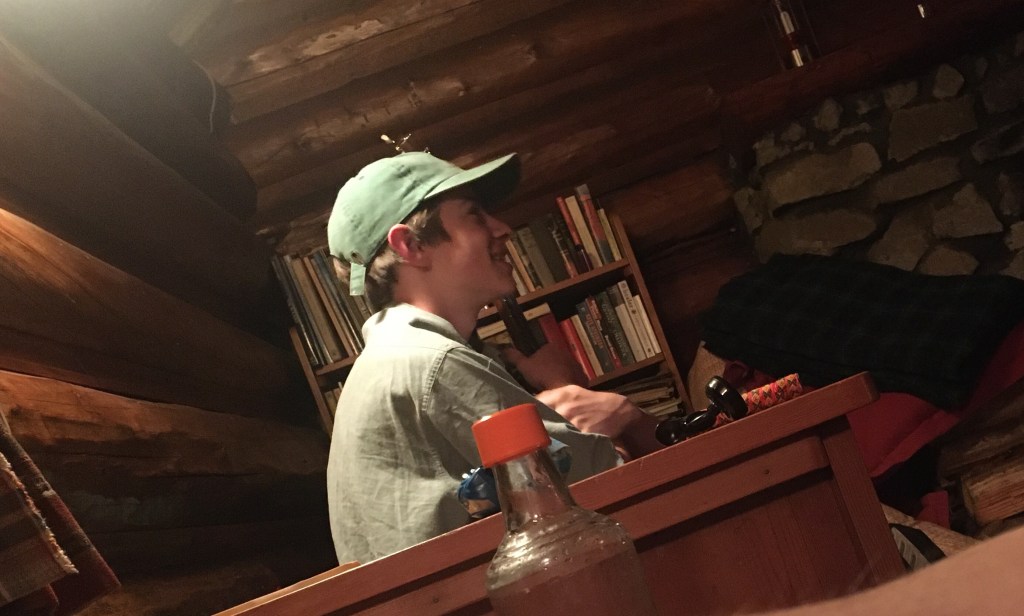
Through the cabin walls the muffled voices of a single banjo and guitar, and the swerving, deepening voices of teenage boys reach my ears. Behind me the chop and dull thud of axe into wood and before me over the occasional chirrup of a bird and familiar jingle of our dog’s collar I hear the steady hum of Goat Creek.
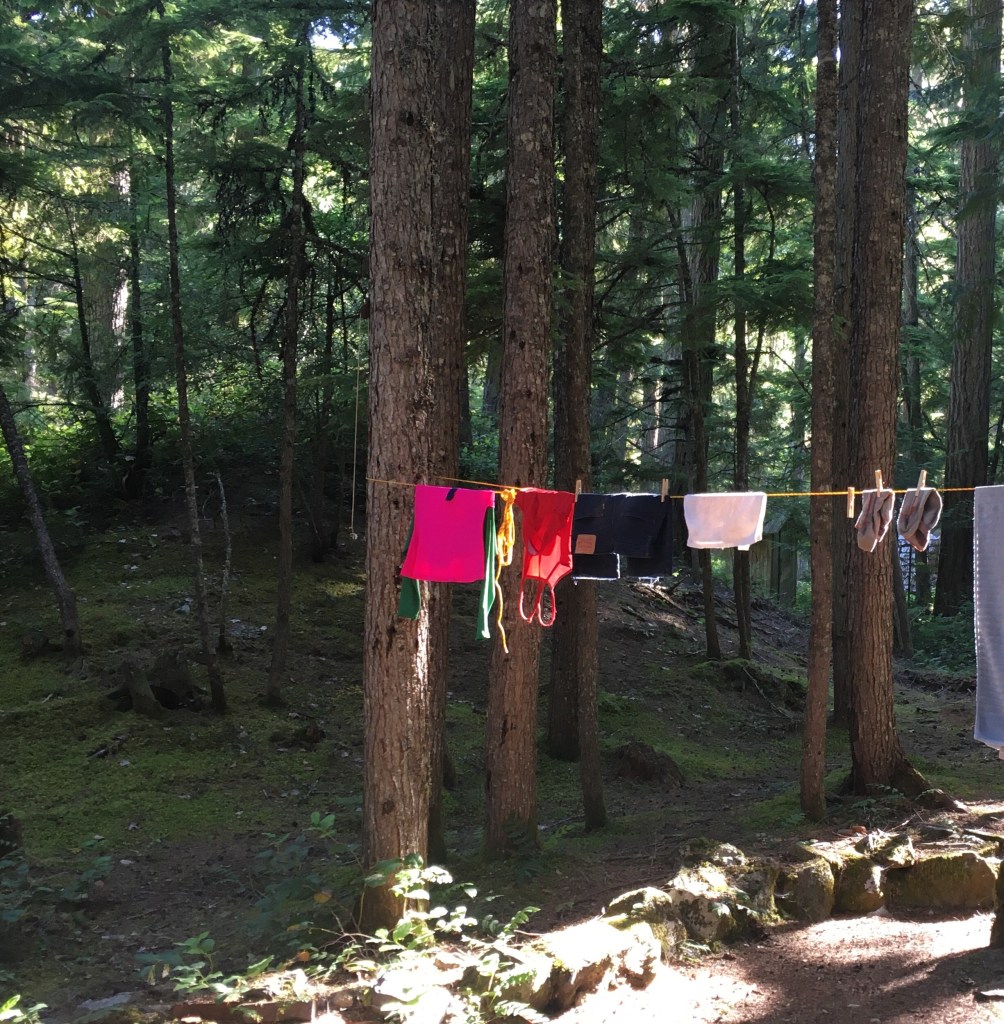
To my left hang a colorful string of swimsuits and towels, hiking socks and stained t-shirts, like prayer flags they promise peace and sweet memories of a week well spent here in the mountains in the shadow of Mount Rainier. The bright pink and green of my swim shirt catches my eye and reminds me of the water all around, the countless swims I am so grateful for, and this life I am living as best I can.
Sunlight filters through tall, slender fir, hemlock and cedar trees, lighting up the carpet of dry, bright green moss hugging the trees and carpeting the shady ground. I look skyward through curving dead branches and tender new tree tips swaying in the warm breeze to a sky of solid blue.
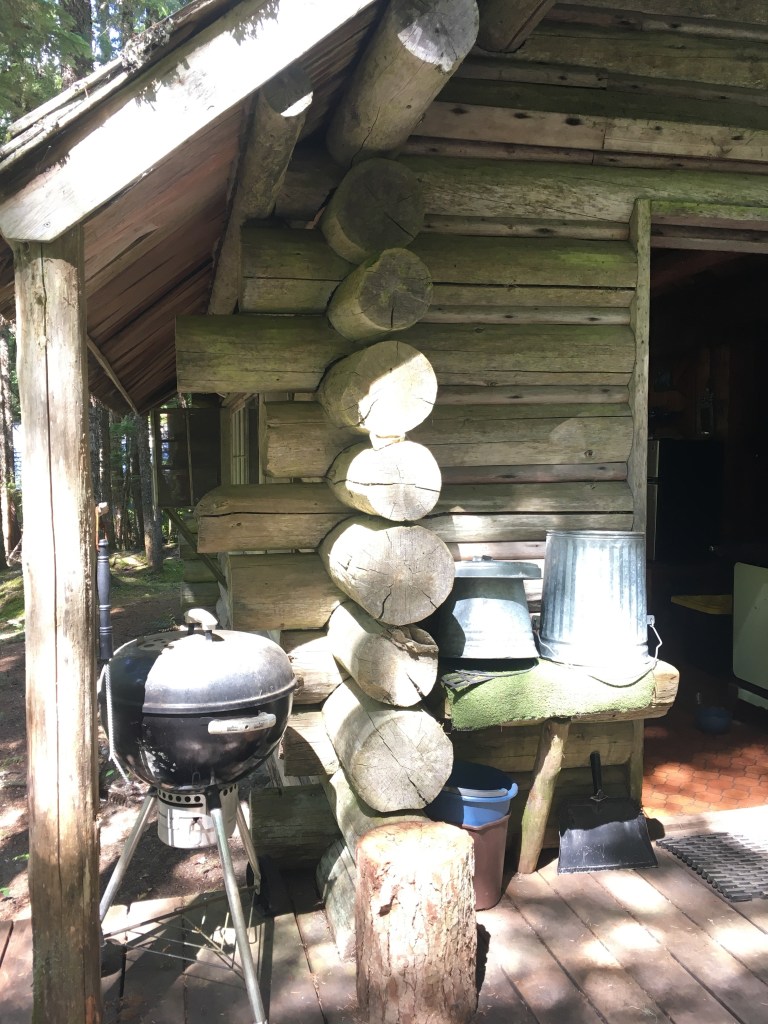
I kick off my shoes to lay my feet bare and warm into the well-trodden dirt, soft and light as cake flour. I wander the outer walls of this cabin, as familiar as my childhood home, a place now inhabited by strangers.
This cabin on Goat Creek remains the storing house to years of childhood memories, my own and our two sons. The last remaining four walls and roof I may still visit to feel and smell and hear and touch edges of log walls and cobwebbed windows where live on stories and songs from my childhood and motherhood years.
Among the pine needles and salal, spiked Oregon grape and ferns, I think I spy the remains of a gnome home my sister and I built years ago. Whispered memories of tiny gnome hats and tales of evil trolls swirl through my mind, as I look to the forest surrounding this wooded oasis. Up the small hill beside the cabin I can still hear the echoes of laughter and muffled cheers from countless sled rides down this hill, once as seemingly big as Mt. Rainier.
Not much has changed here, just all of us.
The musty smell of cobwebs and mouse droppings and wet socks and bacon and donut holes still lingers inside the four walls, and the outhouse still holds that smell that only an outhouse can. The two kitchen doors swing and sweep shut with the same clamber my ears know as well as my sons’ voices. Sounds seep through the tiny cracks between the old cabin walls, muffled and softened as they push through old wood.
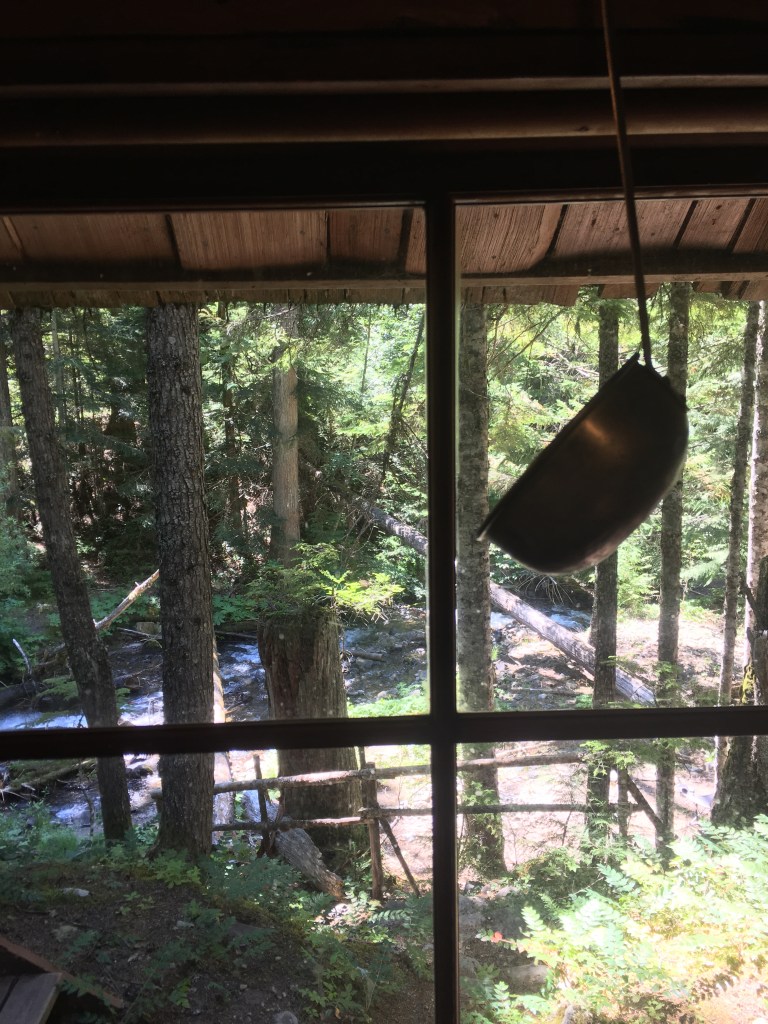
The bank of single pane windows in the long kitchen still opens to a wooded view of the creek below that we still scramble down to for the icy water that cleans our sticky hands, cooks our food, and washes our greasy dishes. Stockpiles of toilet paper and paper towels and Ziploc bags still crowd the cupboards along with a hodge podge assortment of stale soup cans, hot cocoa mix and Log Cabin syrup—all lost in time and space. They stand at attention, along with rows of old and new spices and bottles of cooking oil—guardians of this unique place. Like precious museum treasures this odd assortment of ingredients stay on through the years, almost as if their disappearance would cause the memories to disappear too. I find them oddly comforting, dust and all.
A tin wash basin huddles next to a bar of old green soap near the ice box window, where we stored our food in wintertime before a mini fridge arrived. We still store some of our food there, protected from the mice and a unique tradition solely honored at the cabin.
When I was six years old, my family became part of this place. The cabin log book gifted to us by my dad’s sister is inscribed with a note, welcoming us in and wishing for our family to make many memories here and remember our Norwegian roots through the joy of visiting this “hytte”.
I recently learned that over a quarter of Norwegians own a “hytte”—a small cottage in the woods. The six of us cousins who were brought here from a young age, also happened to be a quarter Norwegian. My siblings and I have additional Scandinavian blood through my mother’s Danish ancestors as well. Just a coincidence, mathematically speaking, but kind of a cool thing to realize all the same.
The three families that shared this place, including my own growing up, all had a log book. Over the last 19 years the pages in my family’s log book have mostly been filled by my own visits here with my husband and our two sons. Traditions grew organically out of our annul visits or bi-annual visits here. Just as we must read “Axe Handle” from the bizarre book of Norwegian folktales every time we visit, we also never forget to sign the log book or buy a pack of low quality, high sugar donut holes from the Enumclaw Safeway. Traditions are sometimes born quietly, but die hard. Even ones that give you tummy aches.
This latest visit, like all of the visits here over the years, was unique. Just like swimming, no two are ever alike. We didn’t come last year, when the grip of COVID held us home in fear and apprehension. Traveling even this far felt like a bad idea. So after a long spell away, we returned to this place, and for the first time since becoming parents almost 19 years ago, we came here without our eldest son. To keep the number the same, and to the delight of our younger son (and us) we brought along his dear friend, Hugo.
Our eldest had other plans, and though we missed his presence here, we know he was doing what he needed to do.
We filled the week with lazy mornings watching the waters of Goat Creek burble and sing by, spent a couple lazy afternoons wandering the woods near the cabin, unleashed clay pellets with sling shots at unsuspecting aluminum cans, stacked firewood and listened to notes drift off the strings of guitars and one banjo. We ate, watched our dog leap and frolic like a new pup chasing squirrels, read books, drew pictures and lived utterly unplugged—even the emergency land line was down.
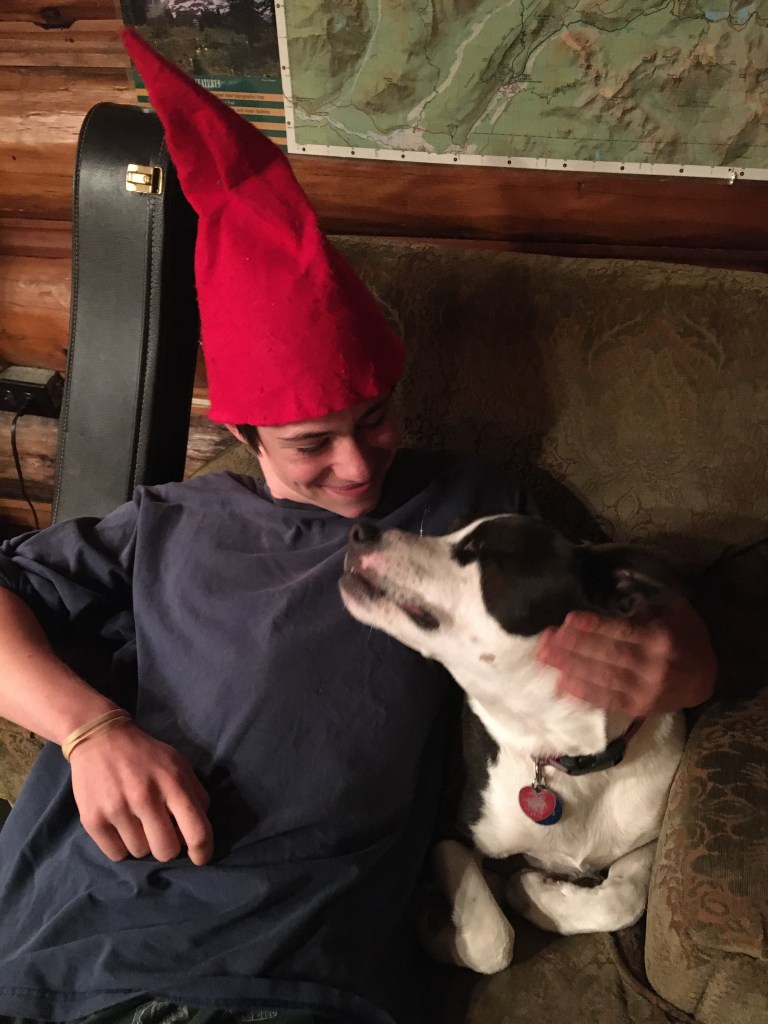
The cabin unlocked playfulness in all of us—including my initiation into a well known game, Dungeons and Dragons. I chose to be a forest gnome. Our son even packed the beloved gnome hat I made years ago for our eldest son’s first Halloween, and wore it proudly much to my utter delight. Even on the verge of high school himself, the little boy in him lives on wild and free.
Bumping Lake
With the hot weather as a motivating force, we drove to Bumping Lake twice for glorious swims, past acres of charred forests, blackened by last year’s fires, past lush meadows brimming with wildflowers, and rivers rushing with runoff from the hot summer melt. We had never been before, but the hot hour-long drove proved well worth the effort.
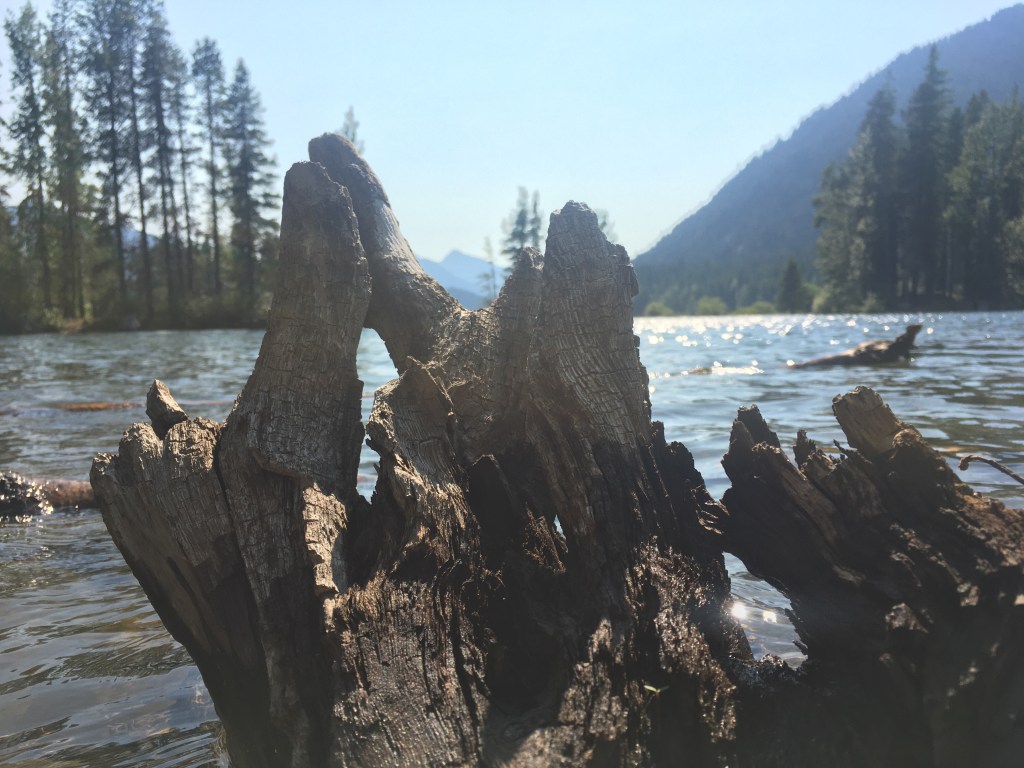
Our first visit early in the week was on a sweltering day beneath cloudless skies. The water was bath water warm, the shallow lake was a mottled collection of half submerged stumps, ringed by leafy trees and grasses. Shallow water hiding submerged tree stumps made for a largely boat free swim, save the occasional paddle board.
I swam easy over a muddy bottom, past submerged stumps, the familiar unfurling of my body soothing and kind. The salt-free swim was a surprising change—with less buoyancy to hold me afloat and sweet, salt-free water touching my lips, I was keenly aware that I was not in the Salish Sea. In addition, I happily relaxed into the blissful realization that there was absolutely no chance of running into a stinging jellyfish!
My husband and I took a rare swim together to a small island studded with trees and a few fire pits. I was so happy to be swimming with him, my mountain man not nearly as crazy for water as I am.
This tiny island lies nestled within the lake, an odd mix of submerged forest and watery beauty tucked in the mountains east of Mt. Rainier. The serene lake and clear water won me over, despite my strong distrust of lakes and the plants they contain—especially the ones that seem to reach up and grab you. But this lake was largely plant free, with mill foil no where in sight.
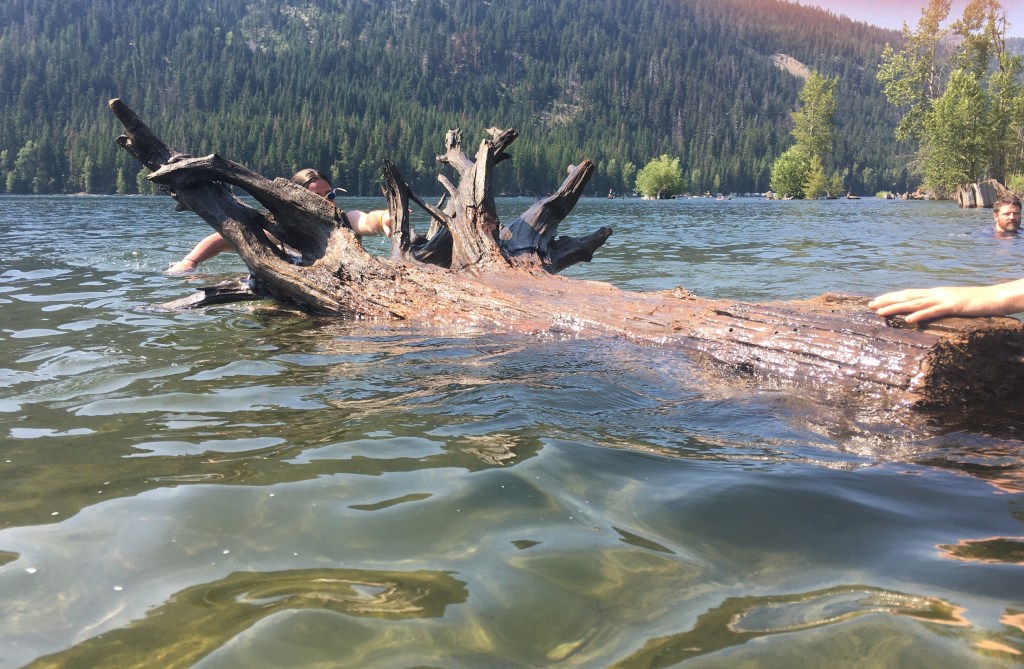
We walked the deserted island, gazed at the sunny water and swam back to our picnic, where the boys waded in the shallows wrestling a giant log between them.
Our return trip a few days later felt like a trip to an entirely different lake. Tall, gangly trees knocked against each other like a bad drummer, off beat and unexpected in a blustery wind. Across the lake beyond the tiny island, white caps danced and fluttered about.
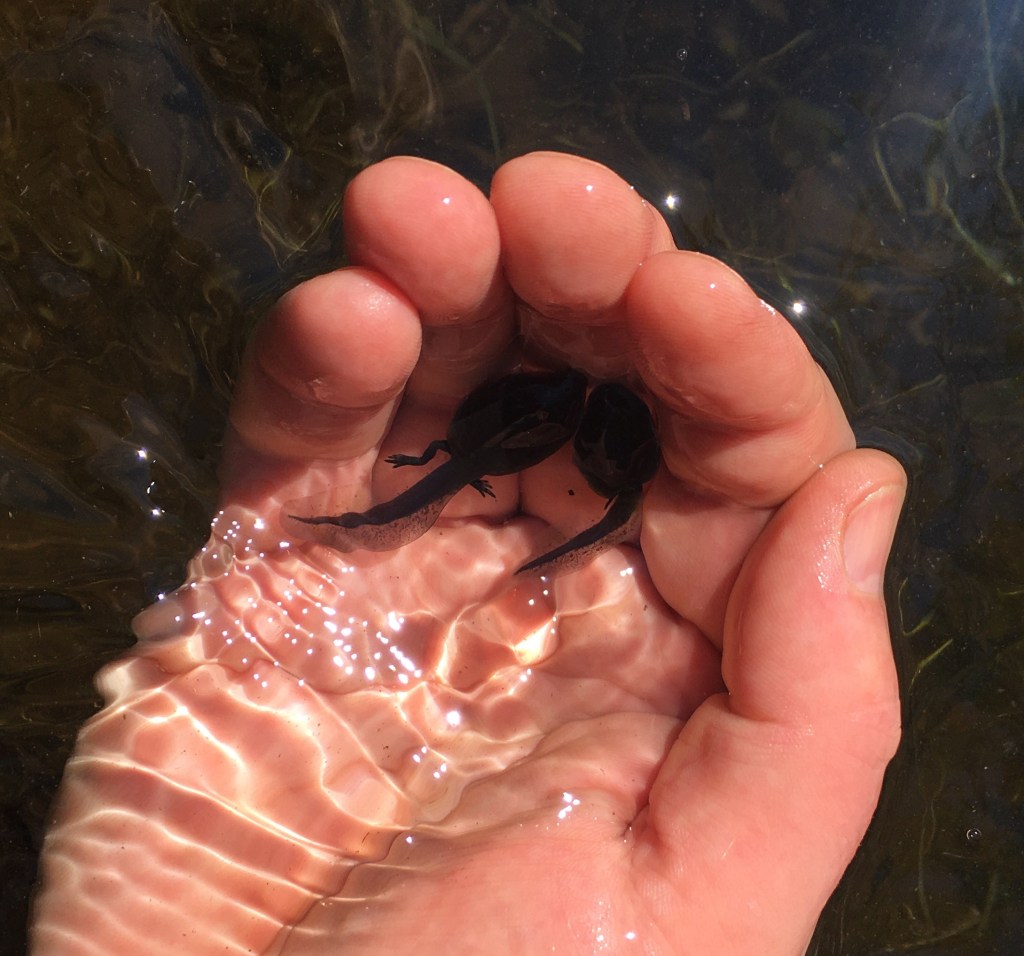
Anders’ friend and I, the attending water rats, were not deterred by the colder water and wind, and pushed out into the shallows and swam zig zags in the small cove. We took turns with my goggles to study the world below, and during one of my searches I happened upon what at first appeared to be small, fat bellied fish. As my eyes adjusted to the light, I squinted hard to find myself swimming over a pod of dozens of tadpoles, with tiny back legs forming on either side of their plump bodies. I was ecstatic! Another first in the water—a swim with tadpoles.
I hollered to Hugo and tossed him my goggles to investigate. We spent the next hour following hundreds of tadpoles around the lake. My husband and son joined us to watch these little mysteries wiggle through the cool water. Below the windy water hundreds and hundreds of tiny black tadpoles swam about. They moved slowly below us while we scooped up a few at a time in puddles of lake water to gaze at these tiny miracles of nature. Like plump black plums with tiny tales they traveled in massive schools through the lake grasses.
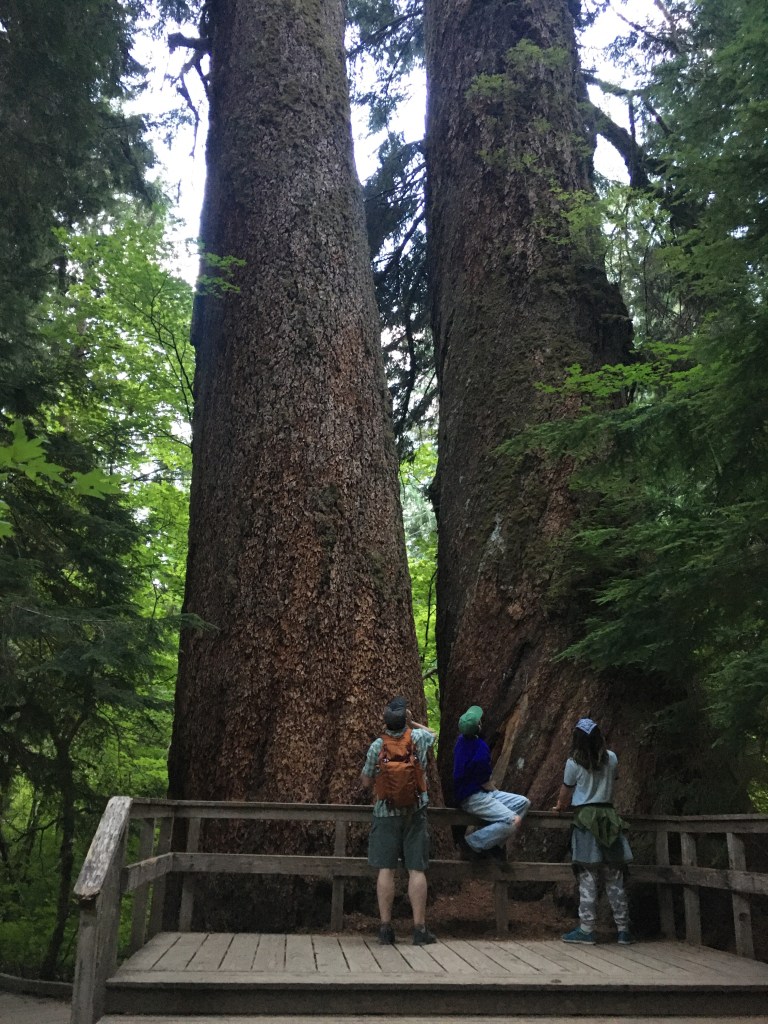
Our cabin trip also included a visit to the Grove of the Patriarchs, where dozens of ancient old growth cedar and fir trees reside, some with circumferences over 25 feet, with birthdays farther back than when Europeans first set foot upon the First Peoples lands of the Americas.
Grove of the Patriarchs
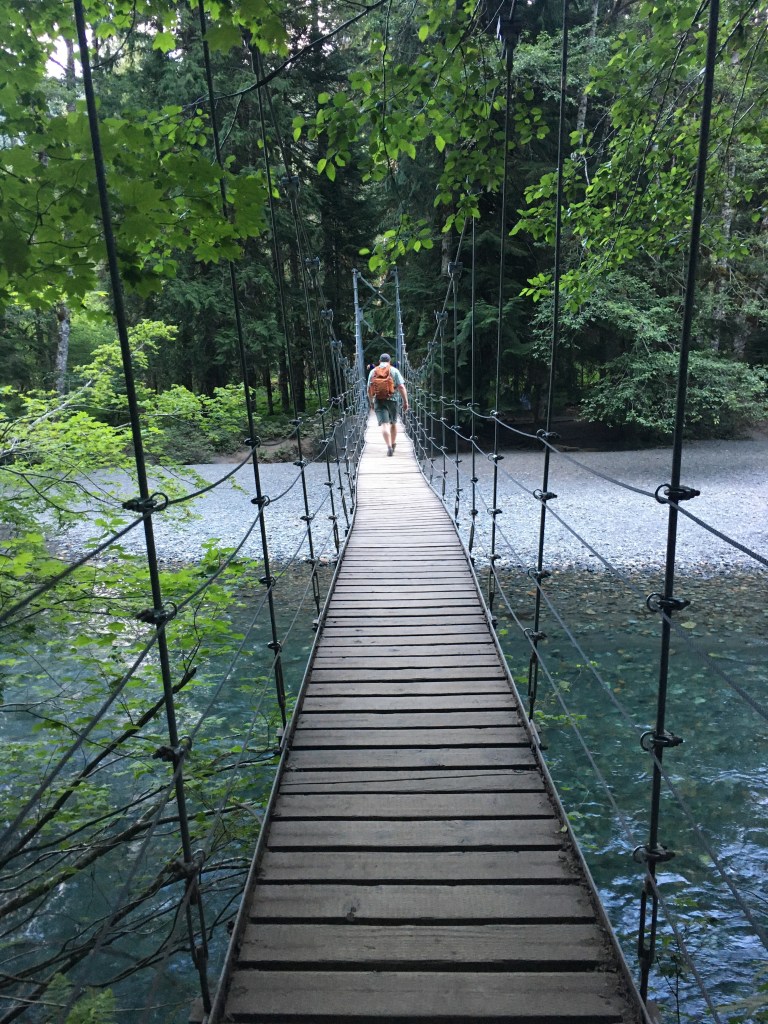
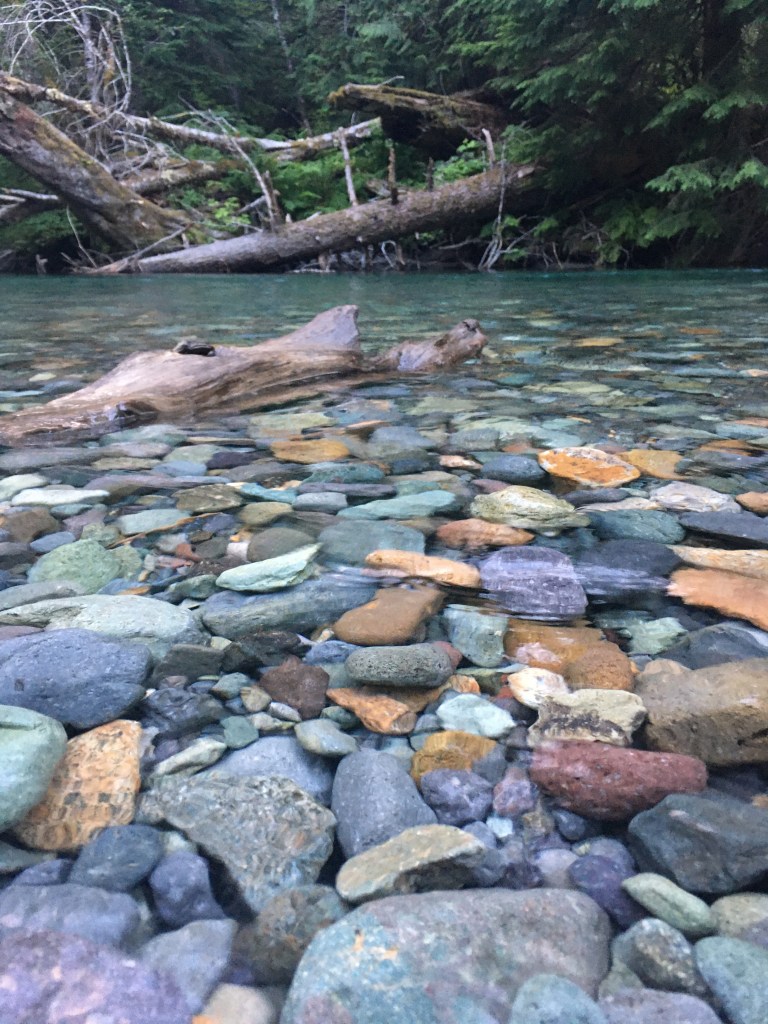
We crossed a suspension bridge over crystal clear water to gaze at these massive life forms, protected upon an island for centuries, fed by rotting logs and seasons upon seasons of snow and sun and rain and wind. These massive trees silently called us to be silent, as we strolled below them, gingerly touching the ancient bark with our soft fingertips, at a loss for words.
Ohanapecosh River
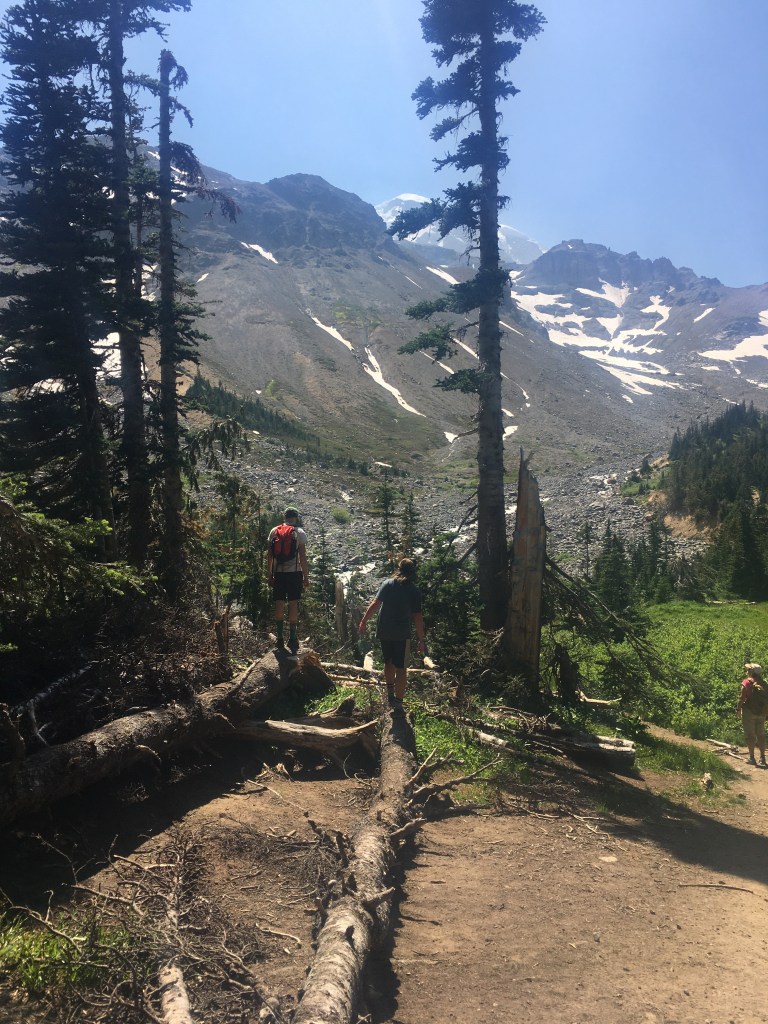
One day we pushed ourselves through a very hot, strenuous hike up towards the Emmon’s Glacier and were rewarded with chance encounters with strangers, including a woman who grew up in County Clare, Ireland, with a cousin who owns a pub that we had visited on our honeymoon twenty two years ago. The world got even smaller in that serendipitous moment!
Glacier Basin Trail
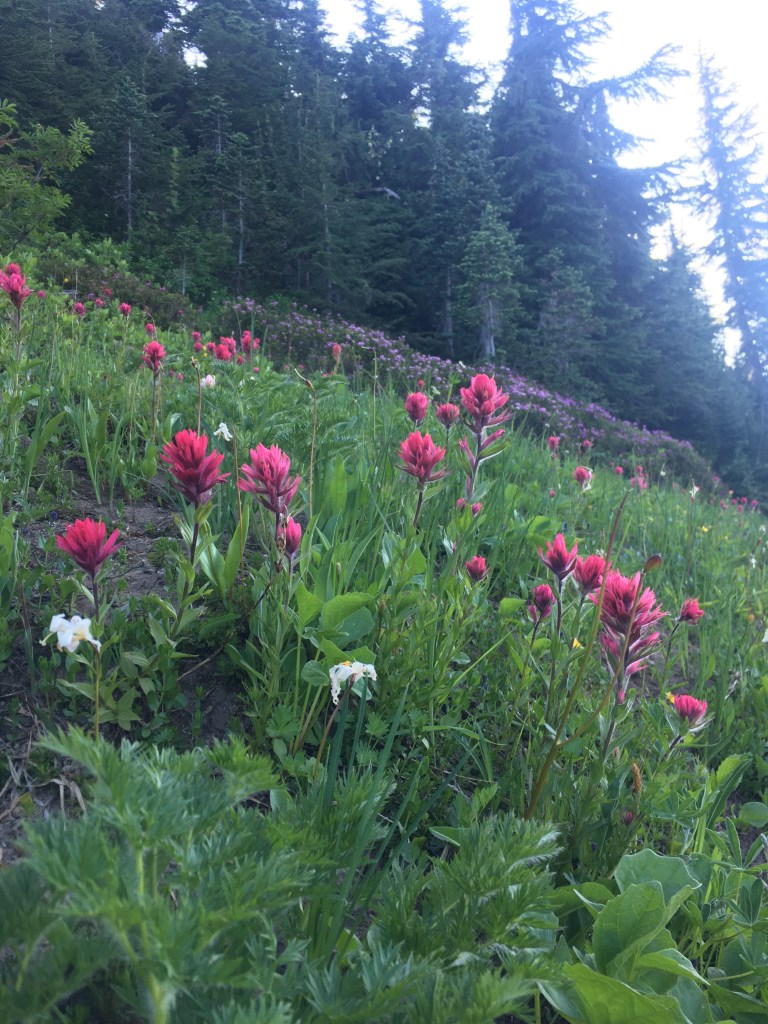
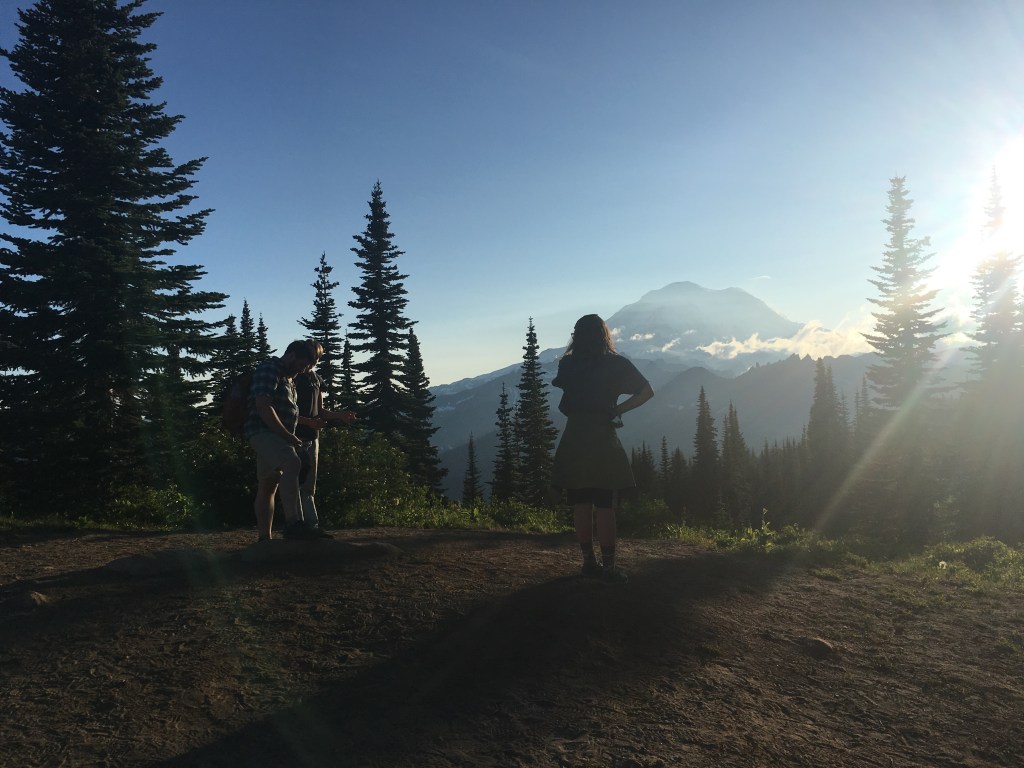
We went high too, around the Naches Peak Trail one evening, and walked through a three mile rainbow of high mountain meadows bedazzled with wildflowers.
Naches Peak Trail
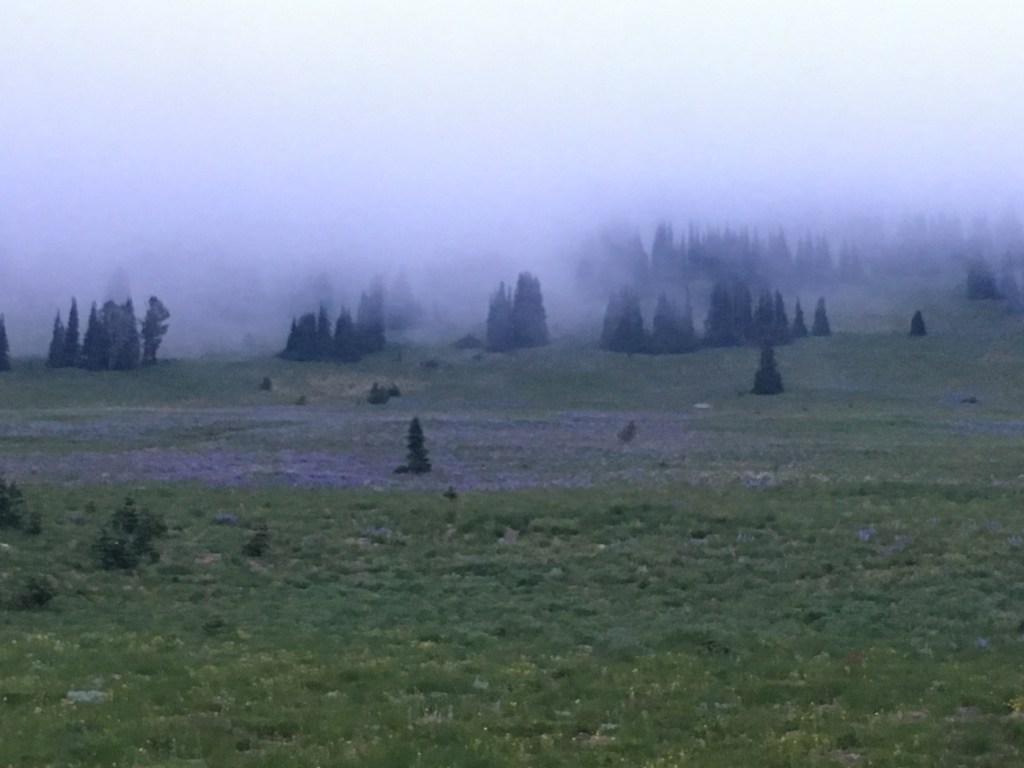
Up at the Sunrise visitor center, just after sunset we watched thick clouds roll down through blackening trees, and over enormous meadows where blue lupin flowers glowed in ethereal beauty, appearing like patches of sky fallen to Earth.
Sunrise Visitor Center, Mt. Rainier
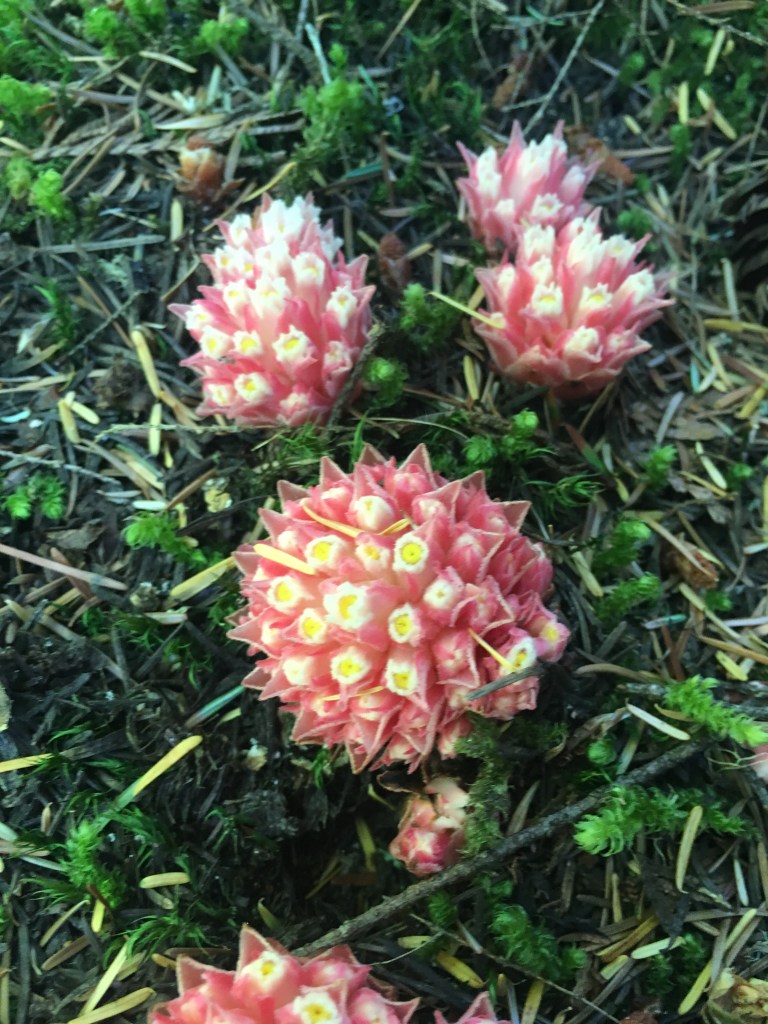
One morning at the cabin my husband came to me, curious about a strange flowering plant he discovered out behind the outhouse. He invited me to investigate this odd little plant with him. We decided it must have grown from some foreign seeds discarded by a former visitor. Fat pink petals rose in compact bunches from a mossy log. Later when we returned home Josh learned that this rare plant is called a Gnome plant. Very rare, this little surprise of living gems served as a sweet symbol of the beauty we witnessed throughout this week together.
The entire week was pretty close to perfect in fact—until I got trapped in the outhouse on the last day.
On our final day at the cabin, when everyone else was still asleep, I strolled out to pee. Since I was alone, I propped the door open with a rock. Better ventilation and a fine forested view. I had just sat down when the door suddenly slammed shut, locking me inside. The force of the door knocked the wooden exterior latch down.
I leapt up, pushed on the door and then I panicked. I pushed and pried and then started yelling for help. A million hours or maybe was it seconds went by my husband arrived in his underpants to rescue me. In hindsight I think maybe the cabin wanted me to stay—or maybe at least remember to appreciate all that the cabin gifted me. Including the cobwebbed outhouse with a plug in heated seat warmer.
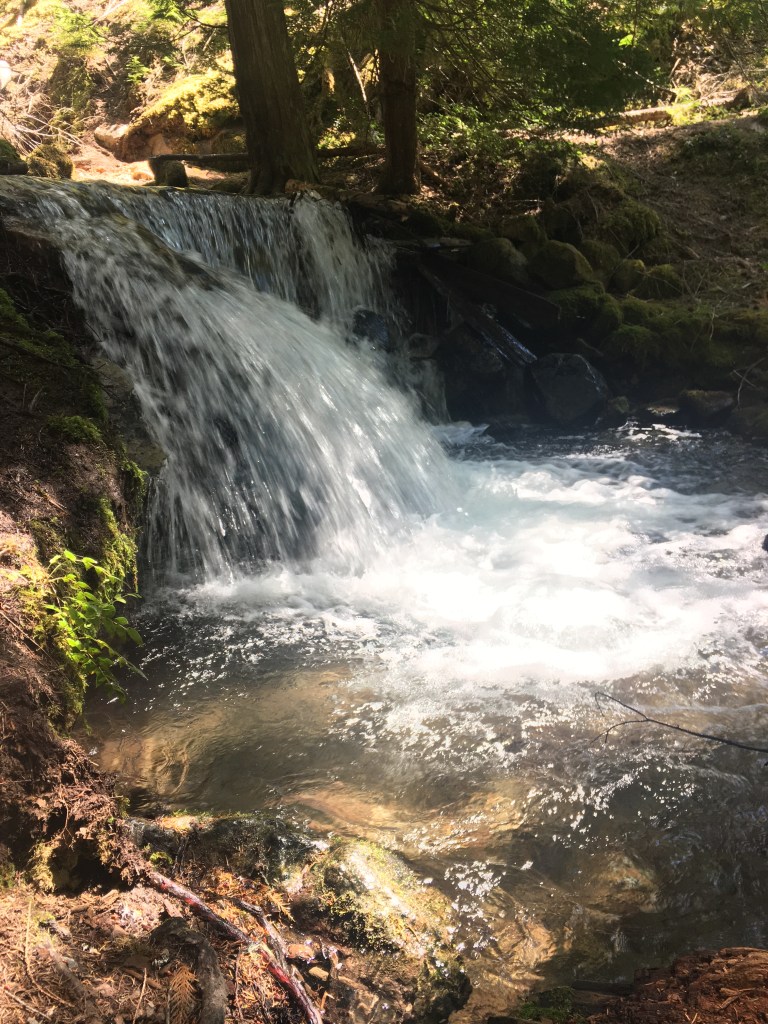
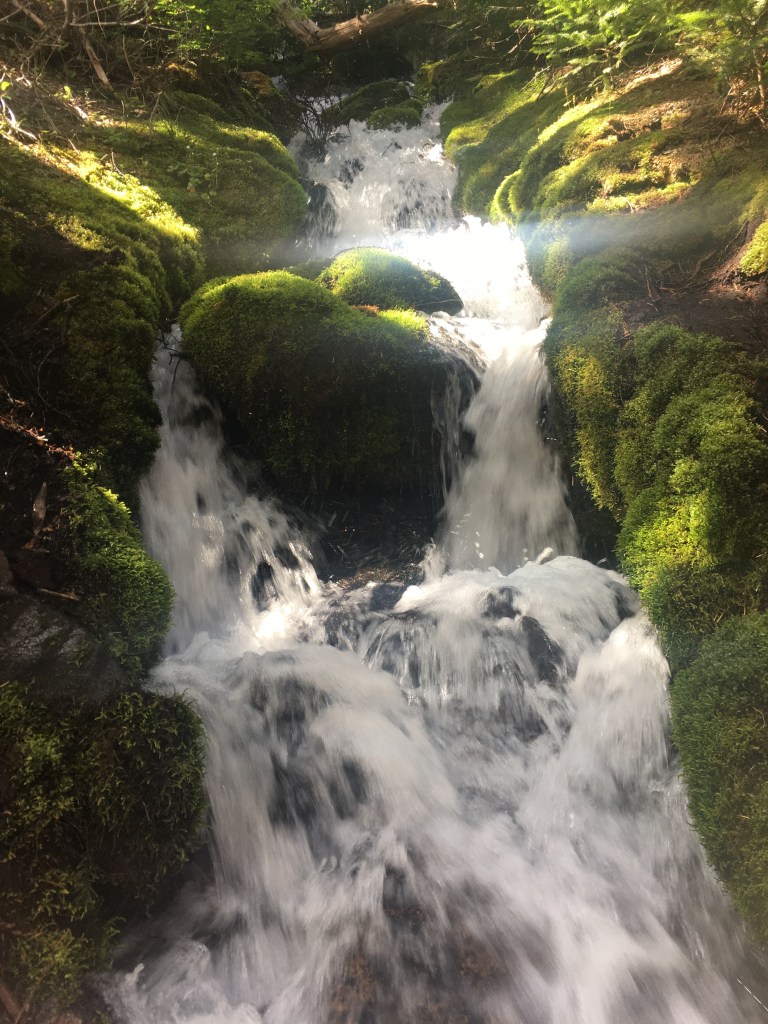
After we packed up and cleaned the hytte as best we could, we said goodbye to Goat Creek. All that week, beside Goat Creek, and on our winding hikes we passed water, running downhill. Tiny streams danced through boulders along the roadway, gushing white water dashed through wide rocky canyons, tranquil lakes ringed by flowers and mosquitos reflected blue skies.
I ditched my clothes one day while out alone with our sweet dog, and dashed into a cascading stream of freezing water, pulled in and under by the intoxicating freedom I find only in water. Once again I found myself untethered and tranquil, cleansed and deliciously content with nothing but my birthday suit on, my dog standing guard, with absolute trust in me. And I absolute trust in him.
Water falls everywhere, making music, and light and life, carving new paths, cutting through stone, smoothing pebbles, creating highways for fish, feeding bears, hatching bugs, growing frogs, moving mountains and making children smile, turning adults into playful children again.
Our first day at the lake I watched my husband and youngest son with his friend roll a log in the water. They took turns trying to stand atop the slick surface, tumbling in backwards into the soft water with smiles as wide as the sun.
Joy and relief filled my being.
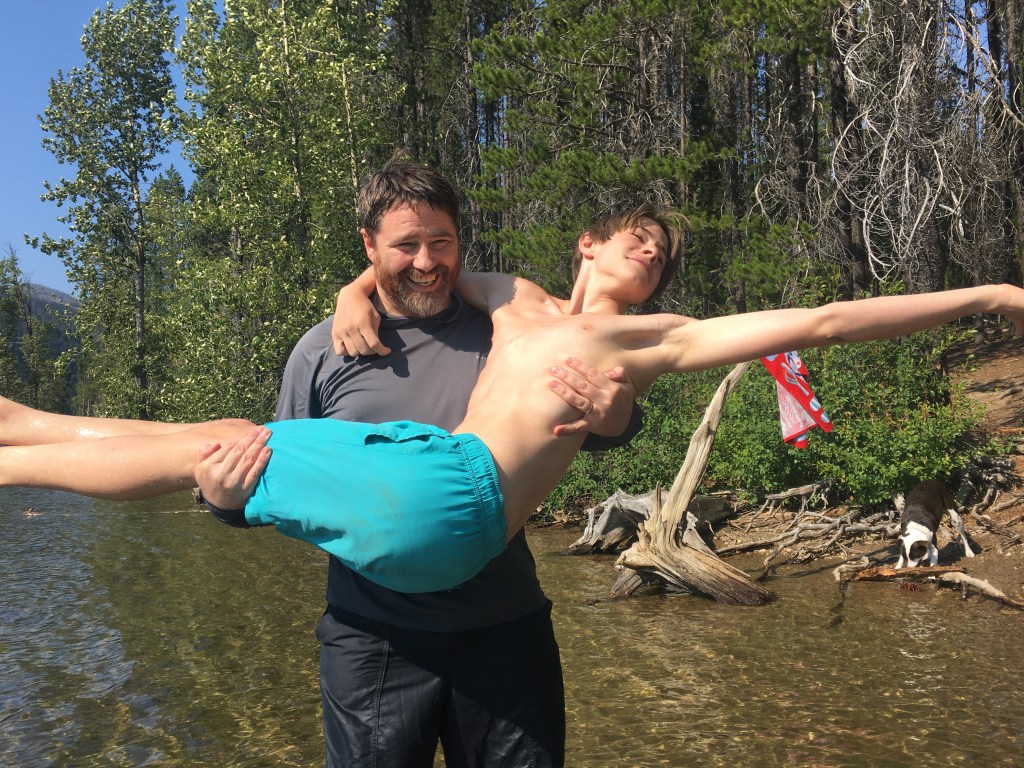
Josh scooped up our youngest son, himself on the brink of manhood, and all I felt in that moment was serene happiness. As droplets of lake water glistened on their sun-kissed faces our son stretched his long body out, confident that his dad would hold him strong and safe.
I long for radical acceptance of the changes that keep coming, the losses and gifts that keep coming. Our eldest is moving out soon, it is his time, and as we lose his daily presence here, mourn the end of his boyhood, we find renewal and rebirth in watching him hatch into adulthood, grow legs strong and able like a tadpole and spring from the freshwater a frog, into the unknown world above.
I long to be the river, flowing down and down over fallen trees, over ancient boulders, over blinding waterfalls lit up by the sun, through towns and along humming roads, past lazy cows in quiet fields, under bridges and through lakes swirling with tadpoles and fish, beside muddy ponds and under pouring rain and silent snowflakes and starry skies to arrive clear headed and peaceful into the Salish Sea.
I, like my husband, will continue to do my best to stand in the water and hold our children up, like the sea, soft and easy, with arms forever open wide to embrace them and love them with all that I am, and they, just as they are.
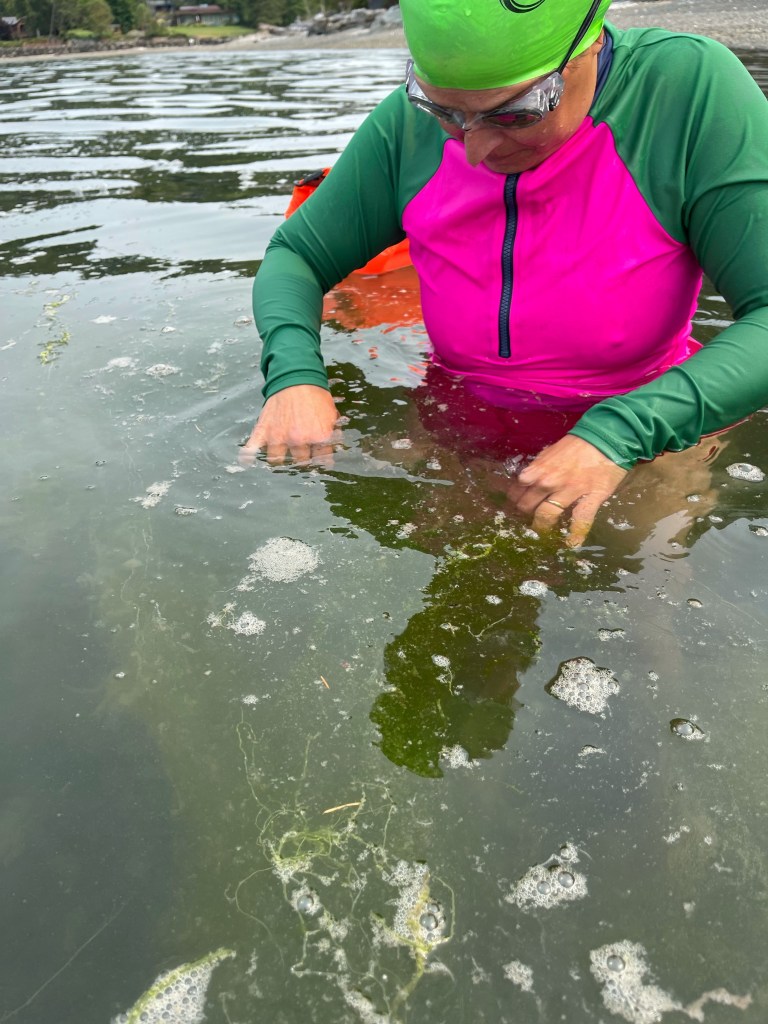
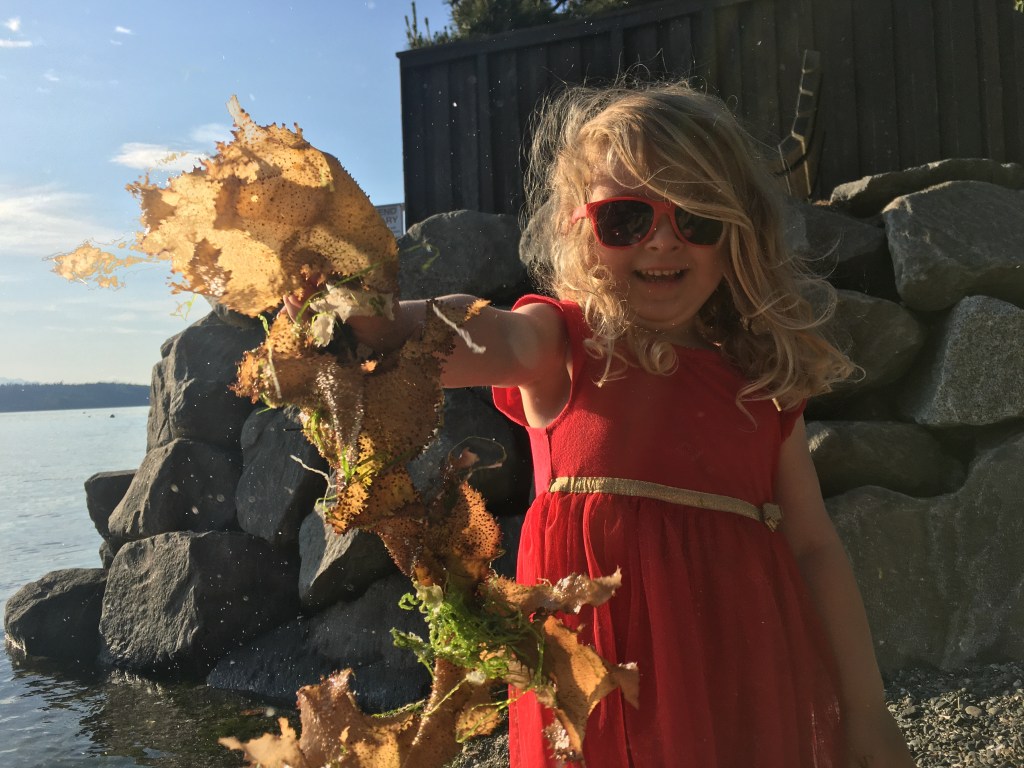
I asked her to hold the seaweed up for a moment—a photo was needed.
Dazzled by her innocence, her spirit, her red dress, her strong legs, her need to move, I saw myself in this young neighbor friend as I exited the salty water the other day. I had begun my swim at the head of the bay, but run out of steam at the landing. My early exit was rewarded with the company of this young sprite, dressed all in red.
As I caught my breath upon the shore, the post-swim calm setting in like medicine, easing my day, lightening my mood, little R. frolicked about, swinging seaweed about and dancing barefoot along the edge of the shore.
With the photo done, R. was ready to move on to something new, with the lightening speed and ease that only a four-year old can summon so seamlessly.
“Watch me climb!” She called, dropping the seaweed to the ground where it collapsed silently onto the pebbles and wet sand.
R. scrambled up to the top of the rock bulkhead on her sturdy legs, as her mother held her wide-eyed baby sister and I watched my younger self looking down at me from above.
I know this girl. That is me. Was me.
“Do you like to swim?” I asked.
“I love to swim!” R. replied.
Her mother added, “Well, she loves the water, but doesn’t know how to swim yet.”
“I love the water too!”
“R. loves to climb,” her mother added.
From high up, R. found a loose rock as large as a melon, sitting atop the bulkhead.
The high tide shimmered silken under the lowering sun. Small waves lapped ashore where a glistening line of bright green and white and brown seaweed sparkled wet and happy.
“Mary, help me push it in!” R. asked.
I rose up and raised my hand to assist my younger self with this singular task. Pushing the rock over the edge.
Two small hands and one big one and plunk! The task was done. The rock landed with a splash among the seaweed-rich water, sending salty drops onto R.’s mother and the baby.
“Wow! What a splash!” I exclaimed.
The red dress warrior girl scrambled back down to join us on the beach. Her blond locks tangled and fluffy and floating around her round cheeks like golden seaweed.
In the water, white and green seaweed hovered just below the surface, in a sea full of brown fuzzy flecks — the decayed remains of countless sea creatures scorched to death in the record heat wave that descended upon the Pacific Northwest a couple weeks ago.
So much beauty in one place.
And here, also, amidst shimmering seaweed and green water calling to me like a lover, gently and sweetly, is a world struggling to hold onto life as the Earth heats up.
I want this world to be here for little R. and her baby sister, as I was blessed to know it as a child. A sea rich with mussels and seaweed and starfish and salmon.
I fear we have gone too far. Billions of mussels and other sea creatures were literally roasted to death by the heat wave, dozens of people died, and the sun still shines bright here with no sign of rain.
The warm Salish waters are such a relief and delight to swim in right now, but as I move through the silken water, my body easing, my heart breaks.
I am overflowing with love for the sea, my steadfast friend, my muse. She wakes me to myself and I become that little girl again, carefree splashing through the shallows.
Like R. I will twirl the seaweed and dance over the rocks at the shore, and hope upon hope that the Earth will keep us.
Before our very eyes the Salish Sea has become a fuzzy wool sweater. Warm and soft to a surprising degree.
I can hardly believe this is the same water I battled for months to accept, endure and let in, as it bore cold and icy to my core.
Visibility remains so low that this past week during my various swims I have nary to spot a single crab skittering along the bottom, failed to make out the familiar shape of my favorite moon snail or even get a clear view of a clam shell resting on the sea floor.
My water life is fuzzy and warm. I’m just not certain this is a good thing.
I have walked steadily in to the water at the landing and barely noticed any cold. The water temperature has risen so dramatically that I love it and want to absorb every sweet drop through my sun kissed skin, but at the same time find myself unsettled by the change.
Unsettled by change. That pretty much covers it. Or maybe the trick is to revel in the change, be the change, move with the tides, shape shift like the water around us.
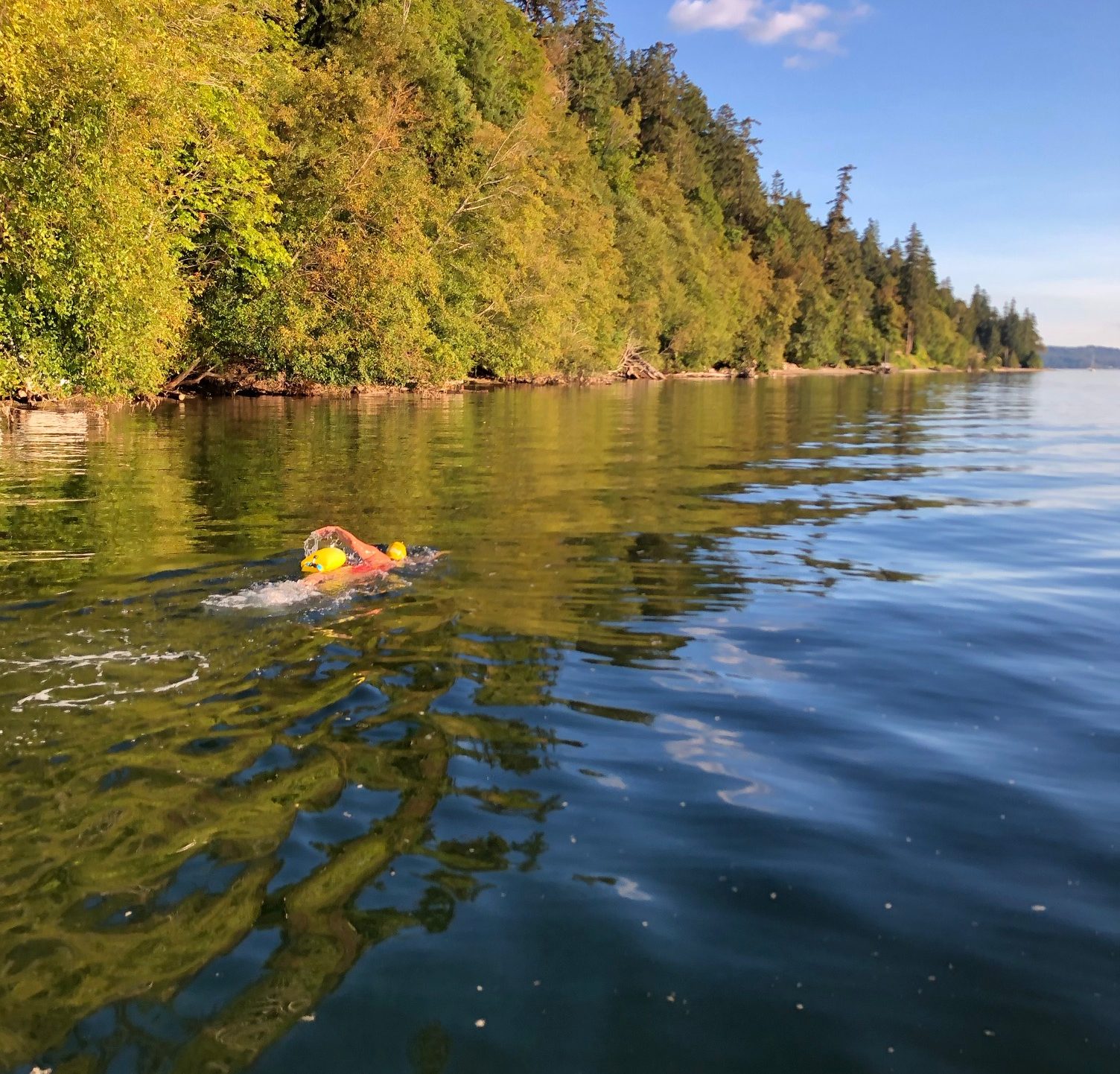
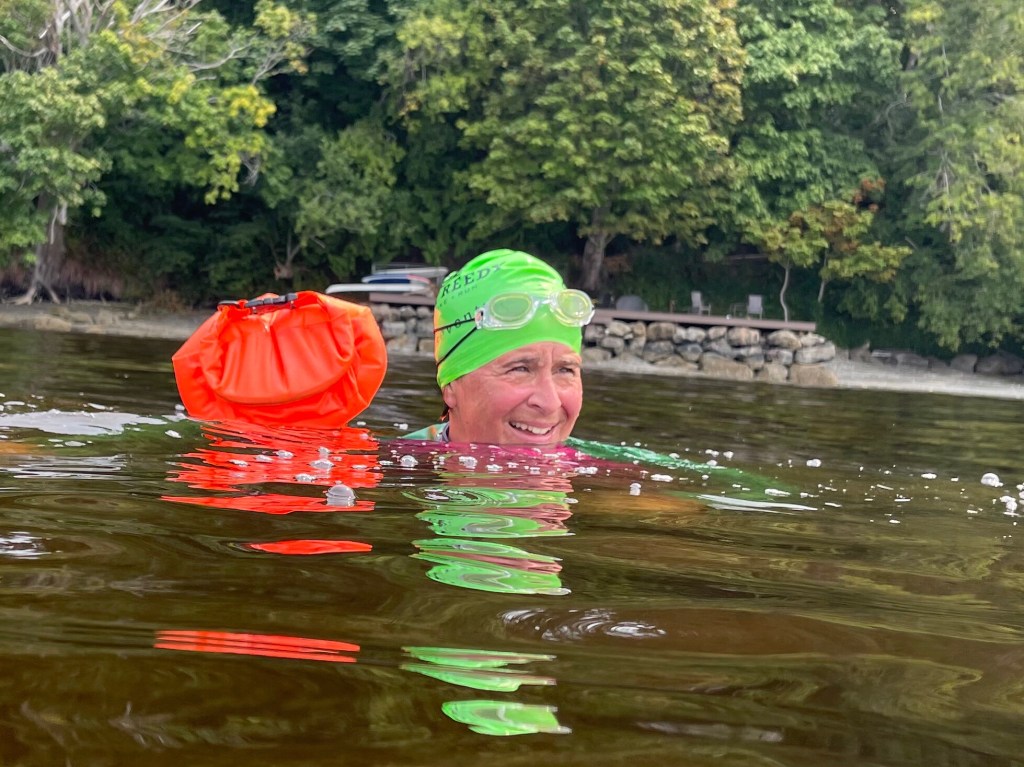
When I tether myself to my orange buoy and pull on my green cap and adjust my goggles over my eyes, I take comfort in this familiar ritual and find my first out breath.
This first breath marks my initial break with the land and all it requires and demands.
Two swims this week blessed me with silken water, windless skies and a bath- like thermal layer free of stinging jellyfish. No boats passed by and no seals appeared—just me alone in an immense salty bathtub full of flecks of mystery and bright green seaweed.
I swim to unwind, rewind, reframe, untether, strengthen, enliven and otherwise liberate my body—my being—from its fragile self.
I must admit much of this seems easier to accomplish quickly in warm sweater water. With the temperature so much higher, I’ve actually found myself scooping water from below me, churning up the cooler water several feet down to cool my body more.
The ease of summer swimming has helped my muscles relax, and for this I am grateful. Summer swimming smells and tastes like my childhood, warm afternoons splashing in waves along the shore, rollicking along in a speedboat, banana popsicles and lemonade stands—and phosphorus.
Phosphorus—nature’s ultimate magical fairy dust.
This is the saltwater’s unique magic. The other night I tiptoed quietly out onto our neighbor’s dock, the bay still and dark, lit only by the dim glow of an invisible moon and some twinkling stars far above, and the bright glow of lights hung from houses around the bay.
My youngest son had enjoyed a swim with friends one night prior, on the 4th of July, in this same water. He smiled recounting their joyful frolic about in the dark, their bodies lit up by bright phosphorus glowing green around them.
I felt simultaneously happy for him and sad for my private ache of missing being the one he spends his time with. I wished to have been with him, but just as with our eldest, I understand that at 14 and 18, their tribe, their focus, their need, is to be with their peers. Not me or their dad much of the time. Our job is to be ready to hear their stories, hug them when they come home, offer our unconditional love and send them off again to swim about in the fallen stars, get lost in the magical glow that is life.
When I reached the float, I dangled a rope in the black water and watched sparkles come to life like watery fire flies, shining and disappearing faster than a shooting star. I kicked off my shoes and sat down to dangle my feet in, swirling them in circles to churn up the green glow, my splashes echoing across the bay. I turned to lay on my stomach, and reached down to scoop up the twinkling droplets, watching with amazement as tiny glitters lit up upon tiny droplets in my hands before disappearing back into the bay.
I, too, was a teen once. I, too, was hungry to feel the sparkles and venture out on my own in the company of my friends.
I felt like a teen again, for a moment, sitting there in the dark on a warm summer’s night making the phosphorus glow. In that moment I shared my sons’ delight, and found myself content knowing that both of my sons have experienced the profound wonder of bathing in this magical water this summer, grateful to my core that they know how to swim and that they, too, love the water.
In the company of friends, aglow in the magic that is unique to them, and all that they are right now, my sons have touched the mystery. What a gift!
Void of salt, void of murk, with mountain water cold like fresh snow
And visibility to 100 feet. 200. 500.
Silvery flashes dot the water. Fish reflecting light, reminding us that life lives here too.
We dive down towards them, frozen water pushes back reminding us that we are but visitors, our thin skin scaleless. The chill is loud, bold but kind.
Only the sky holds this much blue, and endless views.
———————————————————
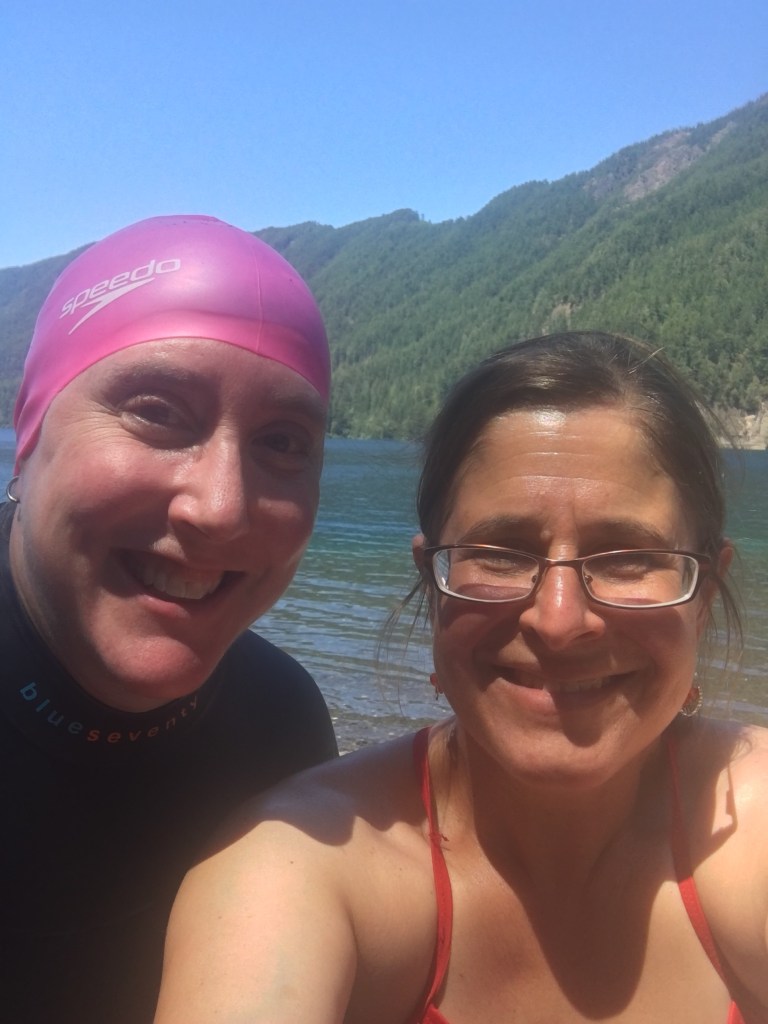
One week ago today I swam in Lake Crescent.
Today I am hunkered down inside my little house, fans running, curtains drawn, bracing for the hottest day on record ever—it’s 10:34am, and already 90 degrees. By 5pm the forecast is set at 100. It’s a good morning to recount my trip to the lake. The heat wave here has turned the Salish Sea to soup, the top inches undisturbed by days of windless skies have literally made the water hot to the touch.
We are all in shock. Here we are in another unreal and unbelievably strange summer. Last year’s natural disasters, included COVID, wildfires and suffocating smoke. This year we are experiencing some respite from COVID with vaccinations onboard, but heaped on top is the fearful realization that global warming is not just a remote idea someplace else. We quietly wonder what fires will spark this summer, and where. What forests will burn?
This week I feel like we are living at ground zero of the heating of our planet.
Time to think about cold water. Never more than this past week have I come to appreciate and treasure the grace of water. The countless ways it heals us, holds us, cools us, warms us—the source of all life.
One week ago today we traded five hours of driving for an hour-long swim.
Yes, crazy.
Worth it? Absolutely.
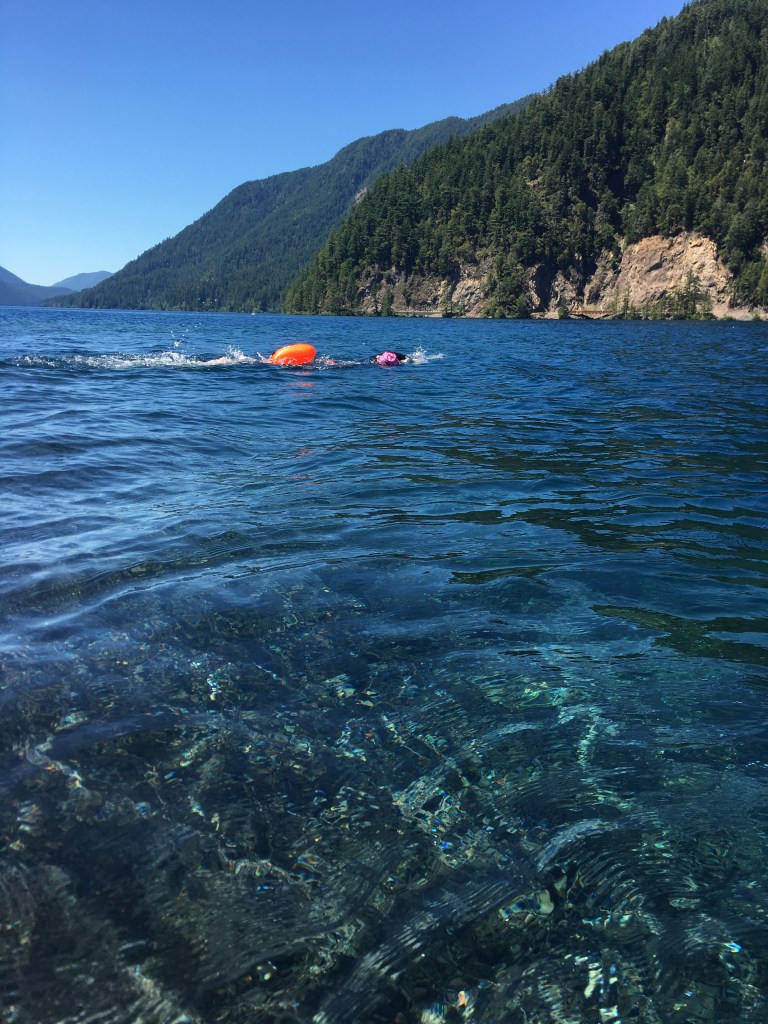
The first time I gazed into the waters of Lake Crescent years ago I was certain that blue tarps were hovering just below the surface. My mind struggled to wrap around what my eyes were seeing—a bottomless blue, so clear and deep it startled me. The alkaline water is mostly inhospitable to plants, fish and even insects are scarce. One could sink down and down and never touch the bottom, or so it seems.
This Monday lake adventure was born out of my unfolding love affair with this magical place, and remains the only lake that I have ever swam in and not felt ill at ease, unsettled by milfoil or otherwise grossed out by duck poop or the dreaded “swimmers itch” that is often mentioned in stories of lake swimming. Steep mountains rise up around the lake, reminding me of the fjords of Norway, folds of deep green trees reaching up to the sky.
Although I am a saltwater girl through and through— Lake Crescent has won my heart. The only downside to this mountain wrapped paradise is the time it takes to drive there. And the burning of fossil fuel it requires.
I remain spoiled by our close proximity to the endless saltwater of the Salish Sea, living on an island with a protected bay mere steps from my home. The jellyfish remain the only real problem, or to be more precise, the fear of getting stung by a lions mane is the only problem. Stings are rare, despite my warnings.
After my recent highly unpleasant encounter with said jellyfish, the promise of a lake swim sounded grand.
On Monday I invited my friend, Liz, to travel to the lake with me. This marked my last day prior to teaching art all summer, just as Liz wrapped up another year-like-no-other teaching middle schoolers—including my son—after what I will always refer to as “the lost year.”
I picked her up at 9:30, both of us giddy with the excitement of an adventure, a swim in a new place and a break from what has been a monotonous time—for swimmers and non-swimmers alike.
As we drove the winding roads to the lake, I recalled that we didn’t go anywhere last year. Save for one day hike with my sister and her husband, we stayed home. Covid fear knocked loudly on our door, seeping into every conversation, with casual encounters with other masked people making anxiety bloom like overactive yeast in warm water, and daily news reports casting a somber tone to the summer—even before the wildfires choked us out and heightened our sense of vulnerability.
Thankfully, life is changing again. Finally. For the better— little things like the fact that Liz and I rode to the lake together, whereas last summer we took two cars to go for a day hike with my dear sister, afraid of exposing each other to the dreaded Covid-19.
Our idea was also a lot of other people’s good idea, and after the long drive we arrived to a very full lot at the Lake Crescent lodge.
Young people and families lined the beach by the lodge, a rainbow of people and floaties and dogs, and in the distance the clear water was dotted with bright yellow and orange paddle-powered craft. The only sounds over happy children and teens giggling and splashing was the hum of an occasional speed boat zipping past.
We surveyed the beach, deliberating on which direction to take for our watery journey.
The icy river to west of the lodge doubled in size since my last visit two years ago, promising frigid waters. I was decidedly hesitant to take this entry, and although Liz had wisely brought her wetsuit, I had not. I was glad I had brought my thermal cap, as the first five minutes in reminded me of my winter ice swim last January.
We swam East, around the bend to the boat launch and back, feeling fearless and free, the clear water shimmering with light, and below us nothing but smooth mud and sand, and an occasional sunken log sitting still as stone upon the lake floor. The logs reminded me of sunken ships, forgotten and absorbed by the world around them, preserved by the alkaline waters.
Liz aptly spotted a handful of fish below the surface, and helped me spot one after much pointing and directing. Surprised I didn’t see them, I commented that my saltwater swimming had my eyes trained to watch for debris, jellyfish and crabs. More surprising to me than the clarity of the water was the complete absence of debris.
Below the surface, the land fell steeply away to our left as we rounded the bend towards the dock.
A wall of deep cerulean blue met our eyes. We paused to rest, struggling for words to describe the view below the surface—an abyss, a starless sky at twilight, watery nothingness. It was equally beautiful and frightening to see, and swimming over the bottomless expanse thrilled and terrified me. I reached back to tug my float, my one tether to safety.
And Liz, my steadfast swim friend, smiling ear to ear, making sure I was okay.
We returned to the lodge, tired and pleased with our mile-long swim, and after a snack we drove the long road home, agreeing that our future swim goals were the same—to simply swim for the sake of swimming.
—-–————————————————-
It’s now 4pm. Temperature outside 100 Fahrenheit (37.778 Celsius). Expected high is 103 at 6pm.
My house is full of teenagers, sunbaked, heat baked, water logged. And hungry. I sit outside in the shade, a few birds sing while our heat pump works overtime keeping the indoor temperature at a balmy 75 degrees.
If I was a cookie right now my chocolate chips would likely be melted by now. My skin is browned after several swims the past few days, in clothes or suit, as I return over and over again to the water I love most. Two days ago I swam mid day in the bay with my youngest son, the surface water was almost hot to the touch. Mid sized yellow and white jellyfish appeared occasionally in the tepid soup, hovering like giant eggs on their way to a good poaching. Yesterday we tried frying an egg on our cast iron skillet in the blistering sun.
I will be patient like the sea, and wait til sunset tonight to go for a swim.
I like poached eggs, I just don’t want to become one. Today it feels so hot I am convinced I’m turning browner like toast just sitting here writing in the cover of full shade.
And to think just a few months ago I was bracing for the deep body chill after a dip in the Salish Sea.
I think about the clam beds roasting in the sweltering sun, and wonder how they are managing this record breaking heat. I imagine that they crave the return of cooler days and waters to match as much as us humans do.
Since the memorable jellyfish sting incident of three days ago, I’ve been back in the bay twice.
Yesterday I launched from my aunt’s dock, after a careful survey of the placid waters, where floated one yellow jellyfish. Like a misplaced traffic light, it hovered a few feet from the float, reminding me to slow down, and proceed with caution into the infinite green waters of the bay.
I dashed up the dock to fetch my camera, hoping to snap a photo of this mysterious creature before my swim, but by the time I returned moments later it was gone.
The water called, and after one more scan into the depths I lowered myself down the ladder, outfitted with my son’s long sleeve rayon shirt. I will make due with it until my new swim shirt arrives. I have decidedly sworn off bare arm swimming in the Salish Sea, for now at least—or until the stinging memory fades or I decide I need a surprise sea flogging again. A dear friend suggested I wear my wetsuit for full protection, but the freedom of skin swimming in summer is too wonderful, and the wetsuit too hot. My selkie suit will have to wait for the cold months to return.
Like the jellyfish, I too, love the warm waters that are swirling around this little island I call home. The warmer weather has come early this year, and with it bath-like water temperatures at the head of the bay—and the early arrival of jellyfish.
Yesterday I scanned the water cautiously with every stroke, but in time eased off a bit and tried to focus on the joy of swimming warm—instead of swimming scared. Easier said than done.
The tide was going out and I could clearly see the muddy bottom inches below my hands as I neared the head of the bay.
With relief I was able to circle out and around the bay, with nary a jellyfish in sight, and capitalized on the presence of paddlers enjoying the bay to ask them if they had spotted any jellyfish. I was thankful for their company, and glad to have their extra eyes to spot the fuzzy pom pom drifters.
Today I enjoyed another sting-free swim, and my first muddy entrance from the head of the bay, where I first began this wild swimming habit over a year ago.
I slipped down through the oozy mud, holding the rope for balance, and stepped in. Small crabs wiggled along the edge of my feet as I scanned the water, where a light breeze cast small ruffles across the surface.
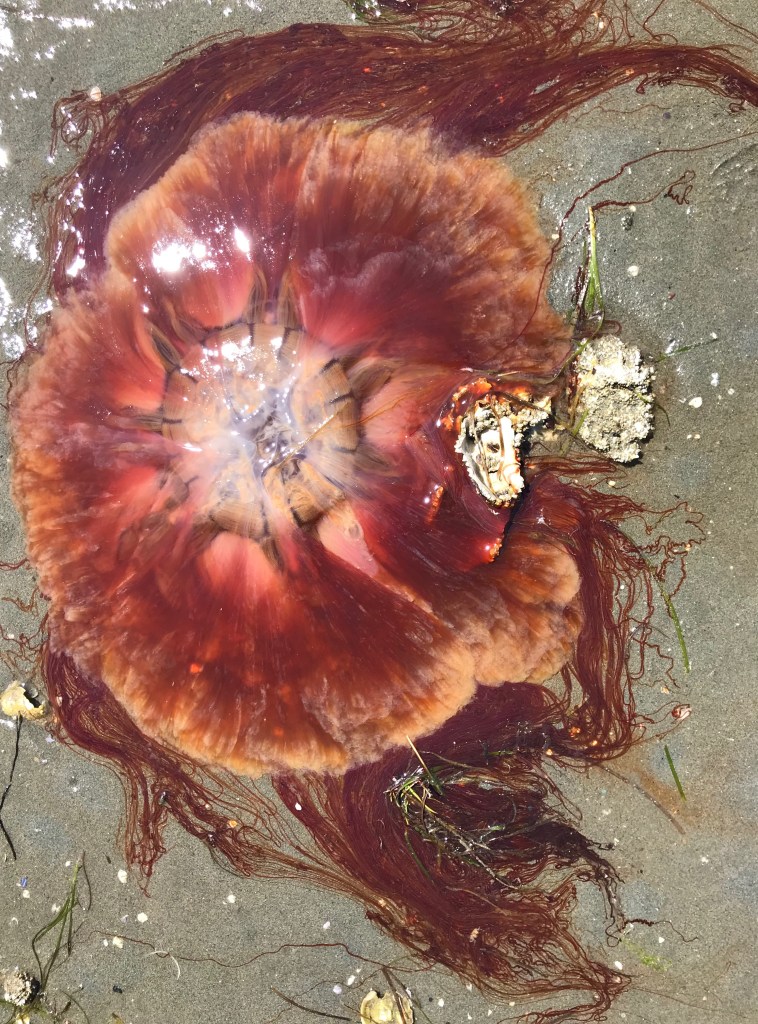
I dove under, the water so warm that any jarring shock of cold was completely absent, and a moment later I caught sight of a red jellyfish a few feet to my right. I quickly flipped myself onto my left side and with a forceful kick shot away from the creature, my breath catching. Like yesterday, my swim began with a bright warning—this one red—and a clear message: proceed with extra caution. This one was the same color of the one that stung me badly a few days ago.
I slowed my breathing before setting out into the quiet bay, the green water like glass.
I love to swim. To my core.
Happiness flowed in as my fear dissipated to the edges of my mind. With the arrival of summer, so too, has returned my desire to swim as much as possible. My stamina is not what it was last summer, and building up strength for longer swims will take time. But that’s okay. I’m patient.
My goal is to swim for the love of it, and on days when I have more energy, I can swim farther. That is the unique magic of the open water—no limits. No edges. Around the world we go!
Today as I continued out towards the mouth of the bay, with my eyes on high alert, I quickly realized that my best view of the water was doing the crawl stroke. Without a wetsuit I am able to do the breast stroke, being free of the awkward buoyancy in the hips which makes breast stroke uncomfortable in a wetsuit. As much as I love breast stroke, on jellyfish patrol I quickly realized that I had a more steady and frequent view of the water just below the surface doing the crawl, and stuck with this stroke to maximize my chances of having time to maneuver out of the way if need be.
As I paused to catch my breath and scan for any threats, I was delighted to discover the familiar shiny head and eyes of one lone seal peering at me from several boat lengths away. It has been several months since I saw a seal while swimming, and this sighting delighted me. I took this as an omen of good things to come, a safe swim, and a sign of healthy waters full of food.
We hovered and observed one another, and I thought again about a Buddhist teaching that my friend Steve shared with me once—
“If you worry about something happening and it does come to pass, then you have lived it twice.”
Fear makes us captives of ourselves.
The seal and I gave each other ample space, and moments after she appeared to me she was gone, slipping beneath the water as silently as a cloud.
After she disappeared I slowly swam forward, and found myself fretting about her approaching me, bumping me or even nibbling my toes. Wrestling my thoughts I tried to focus solely on each stroke, the clear water free of all signs of jellyfish or seaweed.
The seal did not reappear or bump me or nibble my feet. The only danger was my own mind running amok, interfering with my need to stay present of my watery surroundings and keep my breathing steady. I told myself as I had in the past when encountering seals that they are like dogs. Friendly swimming dogs. Curious, harmless and kind. Respect them, give them space and they will respect you.
My mind began letting go of the fear, and I reached the entrance to the bay, where dark patches of seaweed blackened the water below. Outside the bay an algae plume muddied the water, and with visibility near zero, my anxiety rose again.
I really wanted to avoid a sting, and turned back to swim along the inside of the spit, stopping on the steep bank to capture the view with my camera.
With some effort and determination I made it back to the start, where the waning tide exposed a bit more of the muddy bank.
I clambered awkwardly up the familiar roots, my legs shaking a bit as they readjusted to bearing weight again.
I walked slowly home through the ivy in the shade of cedar trees.
I felt strong. And relieved. And so very grateful for another swim.
I didn’t get stung, yesterday or today, but my worrying about getting stung took away from my ability to be fully present.
I suppose there is always tomorrow. Another chance to practice letting go of fear and living in the moment.
I waited a long time for this to happen, and after 14 months open water swimming in the Salish Sea, I finally got stung. Badly.
A small run in with a Lion’s Mane jellyfish, say a small brush on one arm or one calf would have been sufficient.
Nope. Apparently not. I am sitting in a what feels like a pile of needles, prickling head to toe four hours later after a full frontal run in with a bright red watery Pom Pom with 6 foot tentacles after it plowed into me on an incoming tide in shallow water. My face, my arms, both legs and somehow my feet all received a powerful jolt of jellyfish fun.
I have had mini run-ins with a tentacle here and there on occasion over the past year, and in my youth, been stung by bees and birthed two babies at home, but none of this prepared me for the agony I experienced for a solid two hours post-sting. As I writhed around, between splashes of vinegar, credit card scraping, ibuprofen, cortisone cream, a hot shower and nervous pacing the living room clutching a margherita for dear life, my feet aching and my husband looking at me like I was a wild animal loose in his home, I almost swore off saltwater for good.
I cursed the jellyfish, of course, cursed myself for not seeing it, cursed bad luck and even tried to blame my dear neighbor whom I was chatting with beside his dock moments before the fateful red hot collision. Of course he wasn’t to blame, and sweetly offered me his garden hose and a ride to my car immediately following the event.
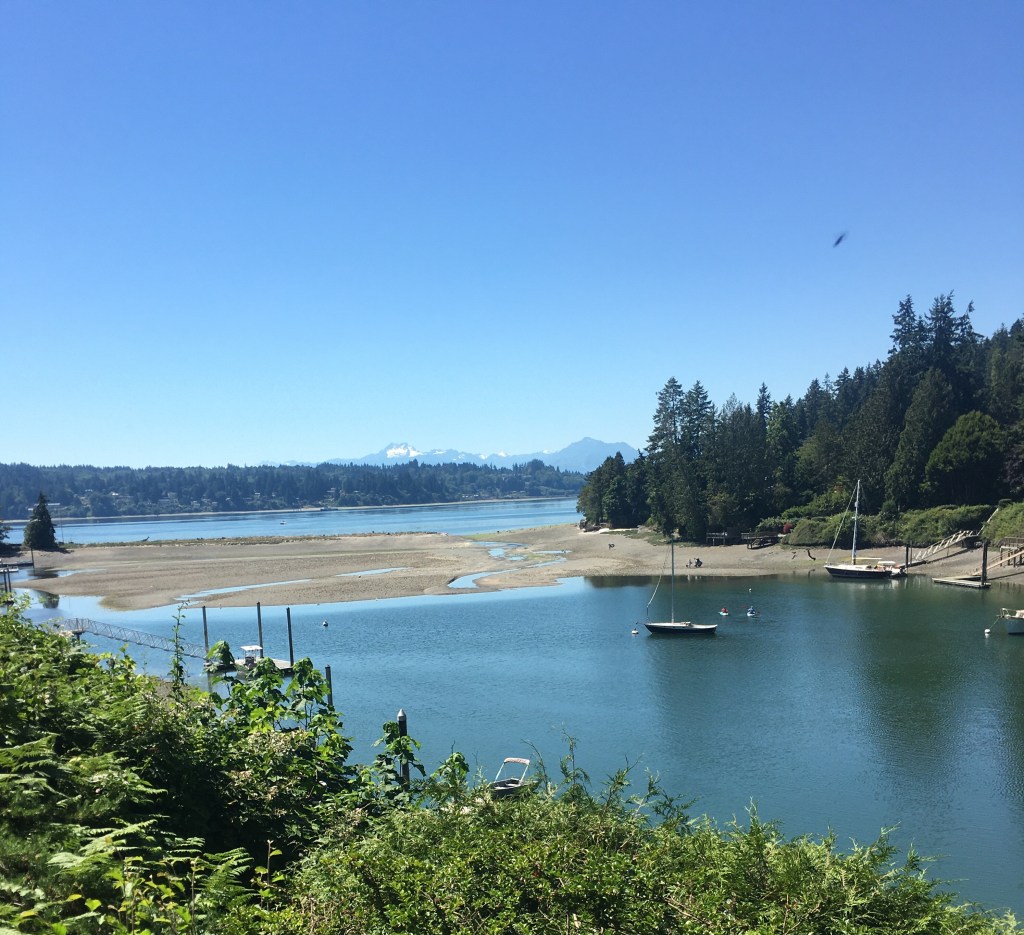
I had been enjoying a deliciously delightful float into Fletcher Bay under sunny skies—the tide carried me in swiftly just inches above the clam flats and muddy shells, the water so low that I was forced to do breaststroke as the crawl would have only given me bloody knuckles and toes.
I kept to the outside edge of the bay, as the tide was so low that the mudflats in the middle of the bay stood like tiny islands, dotted with seagulls harvesting dinner.
I reached the deepest channel near the docks and was able to do the crawl, and reached my friend Bill’s dock, offering a wave. He spotted me and I popped up to stand in the current, hollering words up the bank—suggesting I might need to cross his dock after my swim as the current was too strong to allow me a swim back outside the bay.
We smiled, and waved, and he kindly offered to leave his door open should I need to exit early. I thanked him and lowered down to continue my swim , and it was then that I turned at that perfect moment as the jellyfish of horror was swept into me, across my face and arms and everything else before I realized what had happened.
I jumped up and hollered to Bill. Time slowed down as the stinging set in and my mind caught up with the arching reach of tingling over my body.
At the top of the ramp, Bill inspected my face, as a searing pain set in on my lips and cheek. Plucking a tentacle from my face that I could not see, he offered his hose and I quickly rinsed off.
I didn’t understand that the stinging would get worse—much worse—before it got better.
Once home, the real fun began. My skin started screaming.
My desperation for relief led to a cry for help on FB to other open water swimmers, a quick study on the habits of jellyfish and a surprise text from my dear friend, Mckayla, relaying sound medical advice from her husband—a doctor.
As my skin kept simmering and searing my sanity and the burning continued, a cold foot bath helped, until it didn’t. Tears streamed down my face and my dear husband offered to produce warm water to soothe my aching feet.
The warm water helped. Funny how desperation leads to clarity sometimes, and lucky for me I deduced that if my feet were calming down in warm water then a full body soak in a hot tub would surely be even better. After consulting my friend once more, I got a thumbs up to try a soak.
I made the ask of my friend, Joy, and ten minutes later was lowering myself into her deck side tub. Instant relief set in. She and her family came home soon after and we enjoyed a visit, recounting the shared bittersweet excitement of watching our children’s graduation from high school last weekend, and sharing ideas for how to spend the summer ahead.
I learned a lot today, about jellyfish stings, remedies and have a new and profound respect for the mighty jellyfish. Their stings are no joke.
If my story has scared you out of the saltwater, I apologize. Admittedly, I’m feeling a bit unsure myself about how to get back in and not relive today, but the thing is that much of my story was really good. Sure, I felt really awful for several hours, I don’t expect a good nights sleep tonight and I’ve been humbled by a creature of the sea, but I have some really good friends in my life, and a really kind husband. If I hadn’t gotten stung I wouldn’t have been graced with the show of love and support that I received as a result of my bad luck.
I alone got stung today, but I had four amazing people plus about a dozen more strangers give me support and sound advice from an online open water swim group.
I didn’t want to make lemonade from lemons a few hours ago. I wanted to crawl out of my skin as I cursed the heavens and endured the pain. I kept breathing. I worked through it, but not alone.
I had a team of superheroes around me. My friends are superheroes. My husband is a superhero.
And, yes, I’ll keep swimming in the Salish Sea. But I’m finally going to buy a new swim suit, it’s overdue —and it’s going to have long sleeves.
And yes, I’m coming around to the idea of some lake swimming this summer too. Fresh water has a new appeal I didn’t appreciate until today.
Life got busy, but the tides kept rolling in and out as the minutes turned into hours turned into days into weeks. Or was it just yesterday that I swam here last?
I was a child had a child then another and the moon kept pulling the tides and then bam! 19 years gone by, and our eldest tossed his hat off, graduated and made for the door while our youngest snuck up behind and finished 8th grade, leaving boyhood and our beloved Odyssey behind.
I thought yesterday as I clasped the dog leash and my swim suit in sure hands, Rocky at my side, that I would write again after we both had a dip in the Salish Sea.
I’ve missed swimming these past weeks, I’ve missed writing too, and the word “patience” kept popping up like a bright buoy in the sea that is my mind.
The sea is endlessly patient. When the waters warm enough the seaweed reappears, the jellyfish return, and the cycle of life comes round again. The bees too, wait patiently for the blossoms to open right on time, while birds wait for the worms to appear after a good spring rain, and trees wait for the sun to rise—always patiently. Nature is never in a hurry. Even our hair doesn’t, won’t, grow faster than it should. What is the hurry?
Our eldest spent months so anxious to finish high school, be done, move on to parts unknown. And suddenly, now, he is done. And our time at Odyssey is done and I’m looking for my anchor.
I feel a little lost to be honest.
The faces and days and shapes of the past twelve years as a parent of Odyssey grounded me. Like our eldest I’m feeling a bit untethered, adrift. The lonely year behind us stripped us all down to fish bones. Raw and brittle—and we got stinky too. I missed our school community and the casual conversations and passings at pick up time and the faces of so many students and parents. I took for granted the comfort in really knowing such a caring, diverse group of people, and seeing them daily.
Our graduate of 8th grade looks ahead now to high school, excited and ready for his next chapter. Our high school graduate looks to distant towns, faraway lands, an open map before him.
But I, untethered from this strange but known place and time, drifting away from a school that anchored all of us, find myself spinning like a rudderless boat, my sails flapping.
This is a strange and fragile moment. Slippery like a fish, the feelings real but fleeting as they are too big to catch. Too strong to hold onto.
And I must let them go. Release my catch. Head back to the water and float my body through the days and weeks and years ahead and see what I can see. And feel all that I can bear to feel. And all the while I must remain patient like the sea.
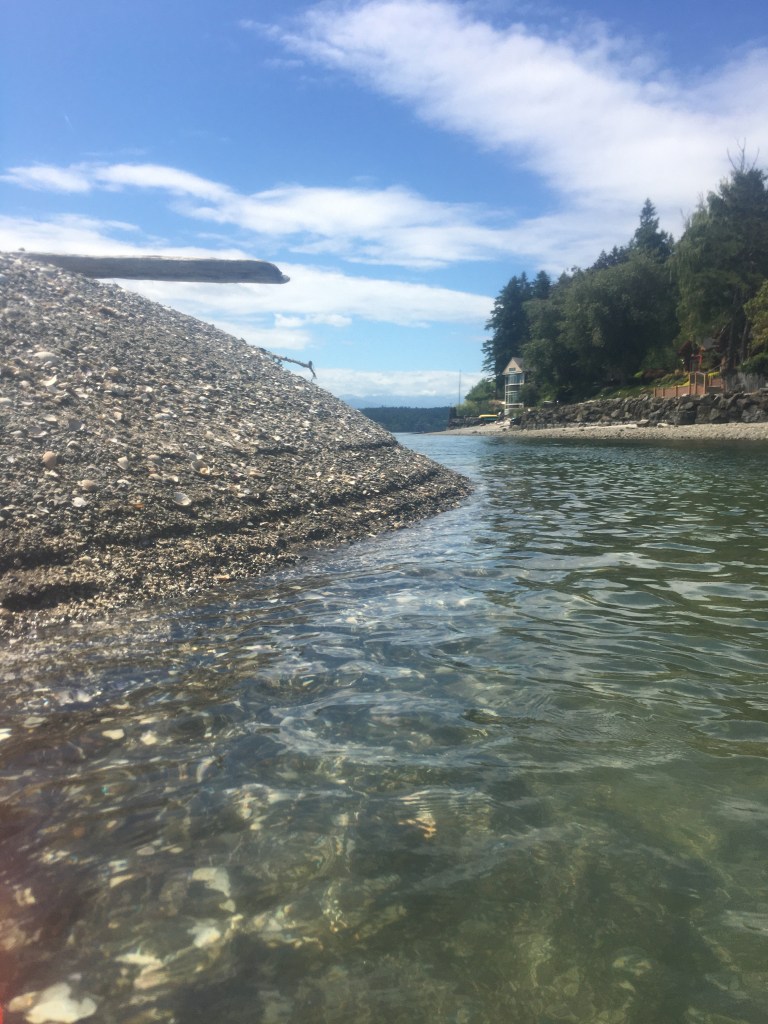
I stepped into the cold water yesterday at low tide, gingerly balancing over the edges of sharp rocks. I placed all of my focus on the bottoms of my feet. I felt my bones bend and lean into and away from the hidden rocks below me, and I breathed patience.
I dove under then broke the surface to swim head above water in circles around the pilings. I closed my eyes and strained my ears to hear the voice of the rippling water around me, reconnect with my water-home. A seagull cried above me. My body eased.
I still have a place here, in the soft water.
And my sons will know to find me here, for I, like their father, am their anchor. And they are mine. My anchor to now, this ever changing moment.





 Mary Swims