The blankets roll in, the watery blankets roll out
Seaweed curls brown along the moving edge of life, while our bodies curl in against the chill to fend off what can’t be won
No one wins here, no one loses here
All are welcome, nothing is lost, just relocated, cast adrift, untethered, unmoored
Things we don’t really need can float away here, to distant shores—not things, but thoughts—the ones that would otherwise sink us, capsize us or weight us down like ballast
Those we can let go—
Yet some treasures, some thoughts are meant to return—the tide ebbs and flows, the currents and winds shift but nothing is strong enough to take them away—
A few months ago I lost a pair of goggles at the landing.
Three weeks later or maybe it was a month I suppose the goggles came back—they were greener than when I had first lost them. Brown specs coated the lenses and a fine film of bright green filled the nooks and crannies.
They hadn’t traveled far, maybe only a few yards from where I’d lost them, hooked around a neighboring barnacle-encrusted rock, but they were decidedly changed. For good.
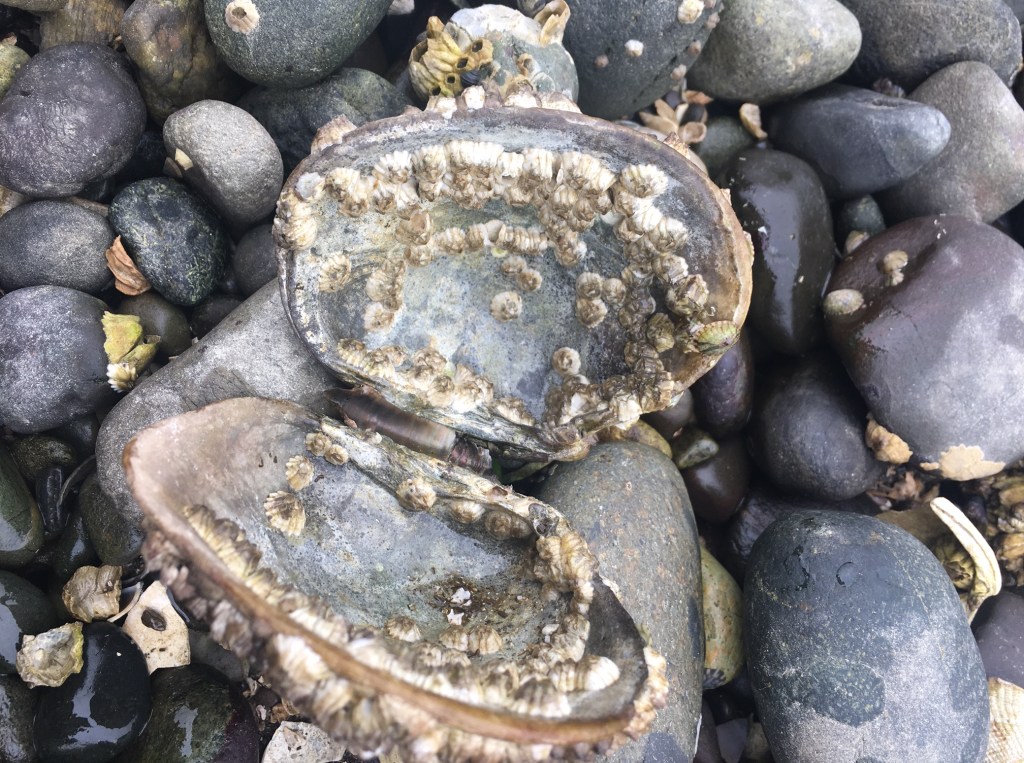
They had spent time alone in the deep, with clam bubbles and crab legs skittering about—maybe they took a ride on a seal’s head or maybe a rare starfish tried to pry them apart or maybe a small child put them on for a spell—only to drop them to watch them sink and settle among the broken clam shells.
Surely the goggles got cold too.
Surely they wondered what they were doing there, what their purpose was, what the point of sitting alone among the rocks was, how they ended up there, if and when they’d ever be found, if and when they’d ever swim again.
Like those goggles I too got lost, coated in a layer of green—spring melancholy and fleeting glimpses of sunshine, dark water and restless energy mixed with a waning resolve to swim or write—listless, distracted, ambivalent even—about many things, even swimming.
Ambivalence about swimming caught me off guard—unsettled me—combined with my stubborn resolve to skin swim and my mind screaming at me to not get in the cold water every time I contemplated getting in.
But I did get in—a few times —and spotted a brilliant pink anemone one day, and yesterday I flew in on the incoming tide into Fletcher Bay so fast I felt I was flying—and three swims ago started leaving my wetsuit at home—and yesterday experienced the after drop so unique to cold water swimming that it left me chilled to my core for a solid two hours post swim, bundled in layers, slurping soup.
But I felt alive. And my husband made me delicious ramen.
And the forecast today says it’s going to be 80 on Wednesday, and I am finding my way again after feeling a bit lost —
Moon jellyfish and sunshine—a recipe for happiness.
My swims of late have been sporadic, with life on land pushing my water life aside. I’ve missed the open water, and with the sun burning bright this week, the call of the Salish Sea has grown strong again along with my resolve to get back in more regularly to my watery home.
Especially now—there are moon jellyfish out there needing company.
We here in the Pacific Northwest are entering that magical time of year when the sun comes out, burning through miles of grey clouds and the world is aglow in every shade of green, making people smile more, plant seeds and frolic outside and birds go crazy in the bushes as new life explodes like a party popper everywhere you turn.
Inspired by a perfect day of warm sunshine and an open schedule, I set my evening course for open water, filling my car with all the necessary gear before work and cleared my slate to make room to swim as long as I liked. Alone. My need to swim, and swim alone yesterday was as clear as the blue sky above me.
Swimming requires a lot of room, especially open water swimming. And yesterday was one of those moments when I wanted the entire sea to myself, room for all of my thoughts and whispered musings to float freely around me uninterrupted. The silence is where I do my best thinking and writing as I swim, filling the corners of my brain with fragments of sentences and ideas to store up and transfer to page once the water has dried to salt on my skin. Or the place to let the heavy, unhelpful thoughts drift away on the tide.
When I can’t get a swim in for days at a time, I’ll find myself stopping in to see what wet adventures my other fellow swimmers have been getting into around the world, via various online groups.
Here is where I go to revel in the pictures and happy faces of strangers I’ll likely never meet, but despite this fact, their splashes and dips and watery posts bring me joy and help me stay connected to that part of myself that is always at sea. I have made a few friends there, including a talented water color artist in the UK, of whose paintings I am now a proud owner.
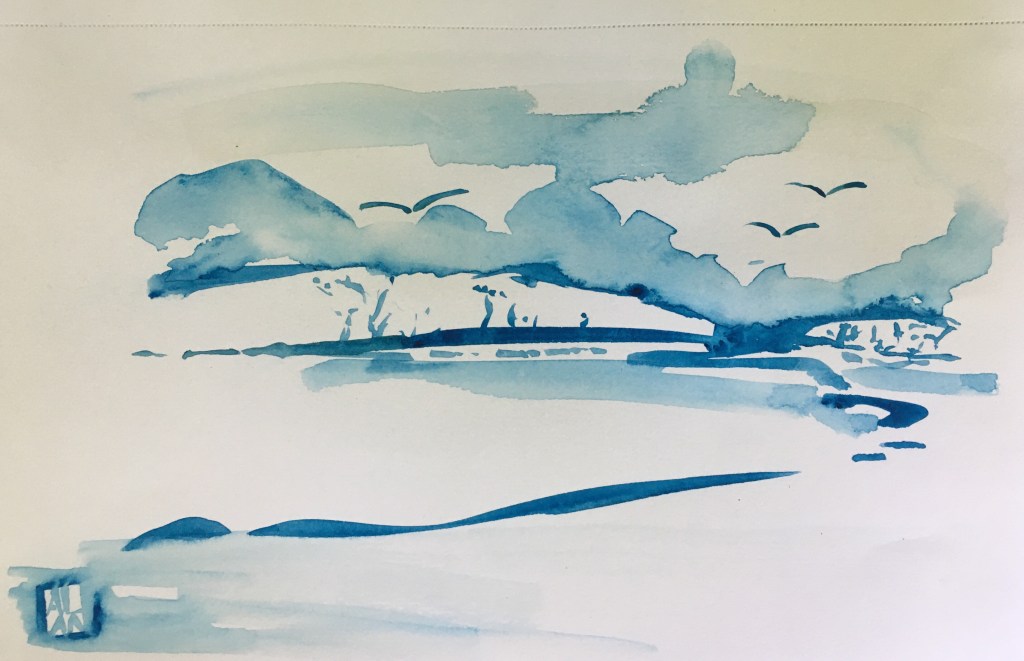
The paintings are small, not much larger than an oversized postcard, rendered seemingly effortlessly by this man’s hand, with water drops I imagine just dried. He takes dips in a river near his home, often biking there and back, carrying his paints and brushes and papers with him.
His posts always include a snapshot of his happy eyes, often hovering a few inches above his fresh water swimming hole, or a snapshot of his body suspended midair, arms outstretched, on his headlong dive of delight into the cold. And always, always photos of lively, fresh executed paintings.
A kindred spirit, working tirelessly to capture in paint the world he loves, images brimming with light and colors, he too, shares his reflections through his chosen medium. I often wish to paint like he does, to share in colors what I see, but words set down in patterns seem to be my truest paints, my strongest brush strokes.
A high tide met me at the landing yesterday, along with silken water, waves kissed with golden light, a light breeze, and a few bright white gulls. The birds soared lazily, etching pathways in the cloudless sky, their black pearl eyes scanning the beach for dinner.
My limited swims of late have softened my tolerance to the bright cold, but the water won me over—in time. A blizzard of tiny algae and organisms of unknown variety blurred my view, as I took the plunge northward, madly blowing bubbles out to distract my mind from the cold, my arms pulling rapidly as I fought through a brain freeze. Lifting my head, the headache peaked, then dulled within seconds, enough time to square my goggles and carry on.
Autopilot kicked in and in no time I was headed into the still bay, the water noticeably warmer here…and then….
A moon jellyfish.
My hand cupped and slid over the unmistakable and other worldly feel that can only be a jellyfish. The silken texture is as close to the sensation of the feel of a baby moving inside ones womb as anything else I have ever felt. Water on water, zero friction. Just perfect symbiosis, two bodies meant to touch.
I doubted my assessment, even as I soon cupped another invisible friend inside the bay. With a pause to catch my breath, consider the water temperature and recognize the fact that it is mid-May, and the air temperature like the water has crept slowly upwards, I deduced that I must be swimming with moon jellies.
Head down again I squinted through the cloudy water and finally started catching glimpses of these translucent creatures. The few I was able to spot measured about the size of half an orange, or a standard paper weight (for those old enough to remember what they used to look like).
I swam from dock to dock, cutting across at the halfway mark, my mind wandering to seals and summer. Anxiety crept in as I reminded myself that a seal might be with me at any moment and I worked to calm my breathing reminding myself that seals are really like friendly dogs—curious and harmless, and due proper respect and space.
No seals appeared, and I swam westward towards the mouth of the bay, blinded by the glare of the lowering sun, pausing to shade my eyes and do sight checks for boats, buoys and other possible hazards.
I found myself peering through dark water, as I pulled along, feeling strong and free, tension flowing outwards as peaceful thoughts floated in.
In the shadow of a large sailboat the water turned an inky black. And in this shadow I did a spot check and thought about how we sometimes have to enter the shadows to find our way back to the light. The darkness startled me for a moment, as I reminded myself that below me lay nothing but a wonderland of clams and seaweed, baby oysters, hermit crabs, minnows and all manner of finned creature. There was nothing to fear here in the shadows, only my own runaway thoughts.
The darkness under and above the water gave me a clear view to my path back to the mouth of the bay, where the brilliant sun radiated warmth and light, drawing every magnificent color to my eyes—a perfect painting.
*Below—Original watercolor by artist and kindred swimmer, Alan Turner
Today feels like a good day to write you a letter. I am only a mother because of you two, and I want to give you the gift of words to mark this day.
You are bound to each other like a clam shell—brothers. Connected and forever a part of the other in a way unlike any other relationship you will ever have.
I ask of you both to do the following:
Return to the water again and again, that life force that brought you here, that element which will sustain and renew you throughout your lives.
Swim in the sea, often. Let the water hold you up and soften your pain and clear away your muddy thoughts. When the waves come in hard and strong and fast, jostling you about and turning your skin to ice and you feel you are sinking, let go.
The sea will hold you up. You will not sink, even when the waves hit their hardest, even when you are blinded by seawater—even when you are alone. In those moments remember that you are never alone. I am the water too, and I will be with you. We will float together.
You will not sink as long as you keep breathing, in then out. Do not hold your breath, for you must fill the sea with your bubbles. The waves will eventually subside. The calm will return and the sun will break through the clouds again.
I promise. I know this because I too have survived the storms at sea.
Peace will return, but in the meantime you must continue to breathe in air, blow out bubbles and feel every feeling that floods you.
And on those sunny days of perfection, when the tide is high and the waters like glass and you are perfectly content and feel full with happiness, rejoice and be grateful for that sweet moment. Take every drop inward to the center of your being and store those up for the hard times. You can tap into that well at any moment, of any day or night. Drink from your well whenever you are thirsty.
Please allow yourself the space and time to feel every feeling. The hard ones, the darkest ones especially need their time. Float with them, stay curious and while you wait for them to ease and soften keep your eyes open and look around. The sea has room for all of your feelings and thoughts. Acceptance and time will get you through.
Pause.
Notice each barnacle on each rock and each whisp of seaweed suspended in that watery world you share. Keep an eye for the crabs shuffling sideways along the bottom, count the clam shells and pray for the return of the starfish. Keep an ear open for the call of the eagle, the high pitched cry of the seagulls above you. Be prepared to meet a seal brother or sister. Do not be afraid. You are of them and they are of you.There is room for the both of you— for the sea and land and sky hold everything. Notice the beauty everywhere.
When you need to rest, ease onto shore and sit close to the incoming tide. Close your eyes and listen to the whispers of the waves.
Know that when I carried you inside me and you rocked in my ocean, suspended, growing, our hearts beating together I took you swimming. Water within water, you swam, my body a boat heavy with hidden treasures.
Back then I had no idea what gifts and challenges motherhood would bring to me. I had no inkling that I could love another human this much, feel so vulnerable, so desperate to protect and determined to nurture and guide well.
You arrived with no compasses, no maps, no charts, no manuals, no recipes, no instructions. Like the sea, of the sea, you both came to us wild and free, shockingly beautiful and fantastically unique.
Keep swimming, my sons. I have more questions than answers as each year rolls by, but my love for you both is boundless and limitless like the sea.
Build yourselves strong boats, stitch bright sails, rework your own charts, use the stars to guide you across the oceans and watch for whales.
And when you need a safe harbor, know that you will always find one with me.
Love, Mom
P.S. And if you ever need a swim buddy, you know where to find me. Nothing would make me happier.
It took me awhile to get here. And my journey has only just begun.
I reached the Pacific Ocean. But I didn’t make this journey alone. Every journey I have embarked on has involved other people, other voices, other stories.
None of us are ever truly alone.
My husband was central to me making it out here, to the Pacific, off the north coast of Washington State. I had a bit to do with it too.
Josh is good with gear and planning and being prepared for all manner of mishaps, whereas I excel in spontaneity, determination and forgetting equipment—this time it was a mask.
After a full Friday of work and chores and an evening gig I dashed home to help finish preparing for our adventure. Our goal was to go to the wilds, sleep in a tent and bravely leave our two teenage sons home alone for the first time ever for one glorious night.
We carefully packed our back packs with dried food and water and hopped into our new used car, drove through pouring rain for four hours, passing by an elk herd and clear cuts and small and big towns until we reached our driving destination—Lake Ozette. Along the way, as the rain drops hammered down and we looked forward into a sky thick with grey clouds, Josh offered alternatives, including a day hike or waiting for better weather another time—even a night at a casino hotel.
I eagerly and happily replied, with something akin to, “ No way. Let’s do this, rain or no rain, I want to sleep in a tent with you and see the ocean!” Besides I had no mask and was hell bent on swimming in the ocean.
The night prior when we were deciding where to go on the Olympic Peninsula, ruling out many places as snow still lies heavy on the ground, Josh mentioned Lake Ozette, a medium sized lake just three miles in from the Pacific Ocean.
“Yes!” I replied. My whole being kicked into overdrive as I anticipated seeing the ocean again, hearing the ocean, and of course, feeling the cold ocean water on my skin. Once we decided, nothing was going to stop us from getting there. I quietly tucked my swimsuit, goggles and cap into my backpack, the latter two items overkill perhaps but it just felt right to have my complete kit.
Our sons were equally thrilled with our adventure, as they had plans of their own. This was going to be good for all of us.
By the time we reached the parking lot at Ozette, the skies had cleared and with delight we strapped on our packs as the evening mosquitos hovered around our shoulders under a rain-free sky. I was so happy with the weather I didn’t mind the bugs.
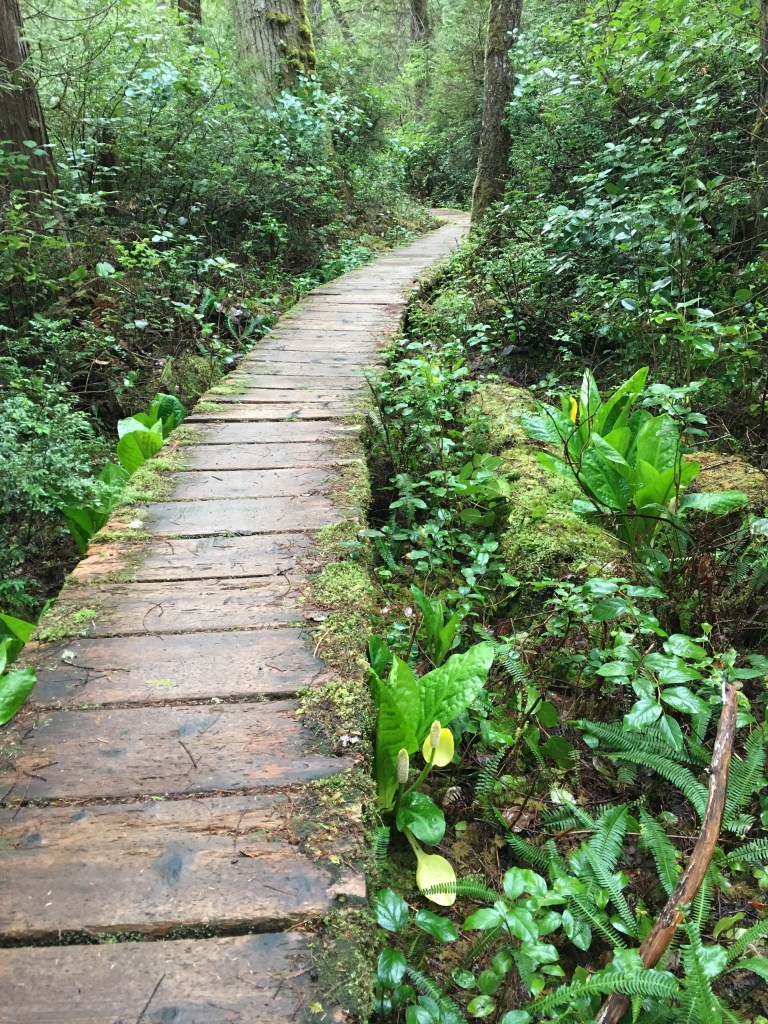
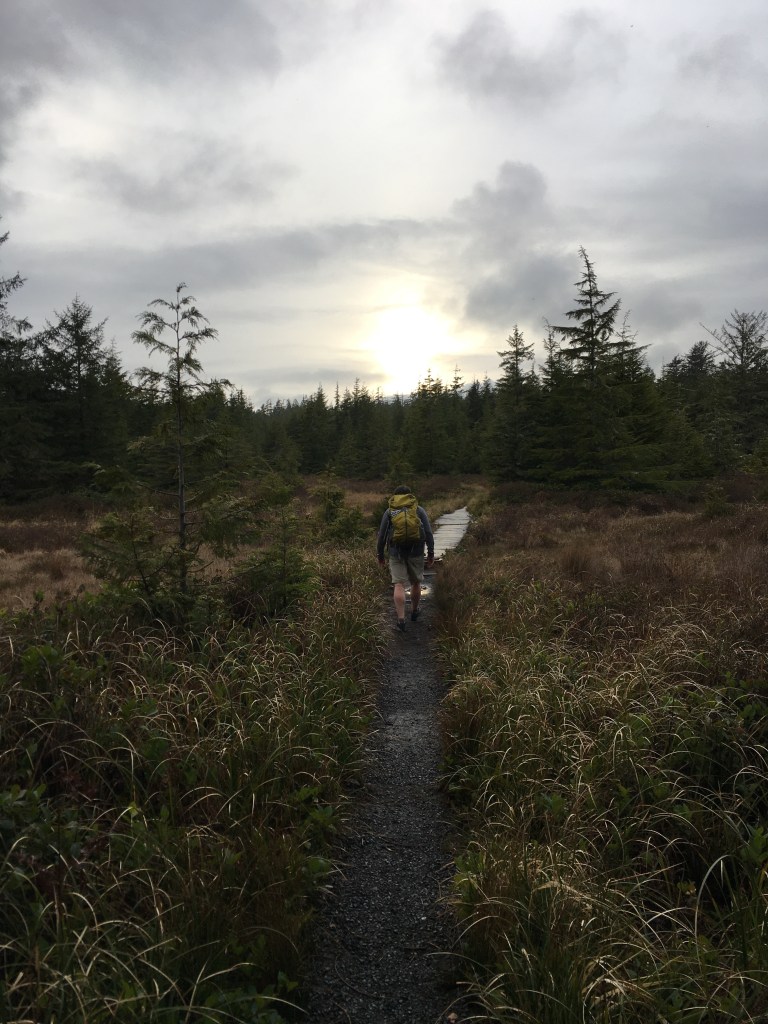
The three-mile hike out to Cape Alava was a magical journey, with much of the trail a meandering stroll over wooden boardwalks built to protect the fragile flora and fauna bursting out of the swampy ground.
Miles before arriving to the trailhead we had driven by acres of skunk cabbage in full bloom, springing from lush meadows and beside shady ponds and pastures. I was thrilled with the chance to see (and yes, smell—so aptly named: skunk) my absolute favorite flower of spring.
Along the trail I was delighted to find this exquisite plant’s glowing yellow flowers and rain-soaked giant leaves glistening, lining both sides of the trail as we made our way to the beach.
We hiked quickly, anxious to reach the beach before dark, only slowed by my endless need to capture photos along the way, my mind easing like it does swimming—each step like a stroke, pulling me towards calm and happy anticipation at what other wonders lay before me.
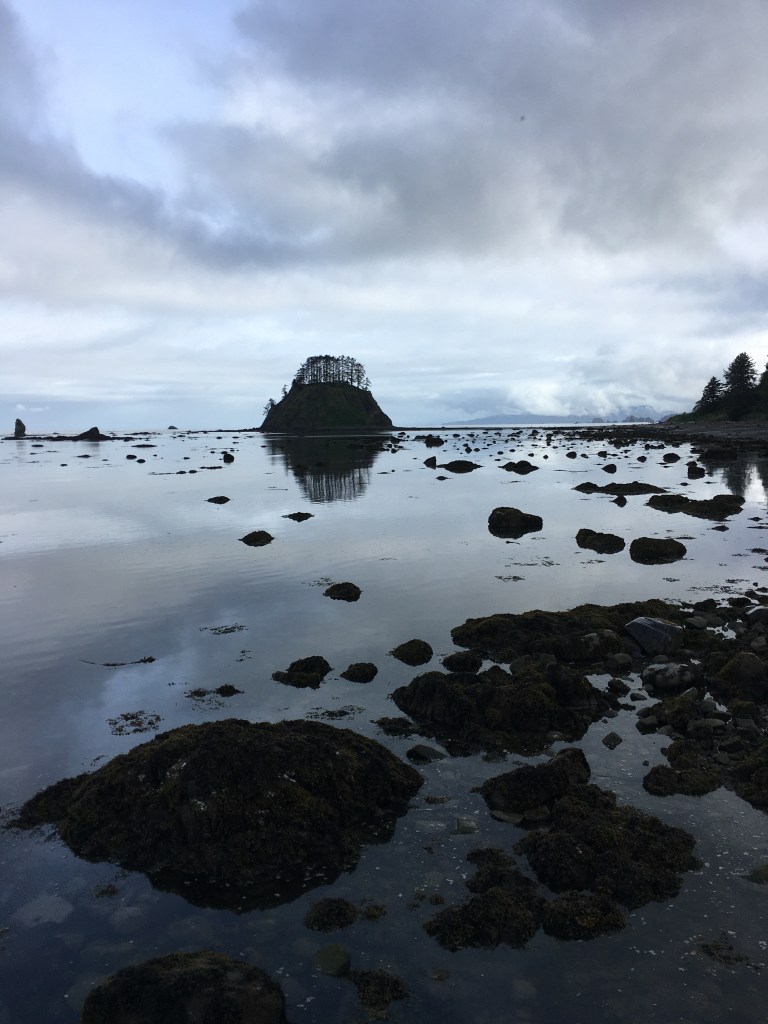
After passing through the woods and a few open meadows, we caught sight of the ocean through the trees. We made our way down the steep muddy trail to the campground, a series of rugged campsites tucked along the shore beneath fir, hemlock and cedar, bordered by a strip of lush meadows. We crossed a log bridge over the small river and pitched our tent looking out over the beach piled knee deep with seaweed and kelp, and beyond to small islands and rocky sea stacks, glowing black as the sun set.
After pitching our tent, a fellow camper offered us the heat of their fire, as they headed off to bed. Another unexpected gift of the day, as we rarely if ever build fires when we camp. Seagulls picked at treasures tucked in the mounds of seaweed, and the cry of eagles broke through the distant crash of waves as we huddled over our dinner of couscous, dried peas and mango, warming our hands over the fire.
The dark came quickly, blending the ocean and sky into one dark mass. With our toothbrushes in hand we sunk step by step through the soft mounds of seaweed to clean our teeth beside the dark water. A few herons fished in the shallows, their long legs like sticks breaking the surface of the water.
In the morning we woke inside our yellow tent, not entirely well-rested, but pleased that we had made it this far. The tide was low and with our hot tea and instant coffee in hand we scrambled over the rocky landscape to gaze at the miles of miniature islands and plan our day’s adventure. As we left Cape Alava behind, Josh spotted a well fed brown rabbit snacking on weeds along the trail to the beach.
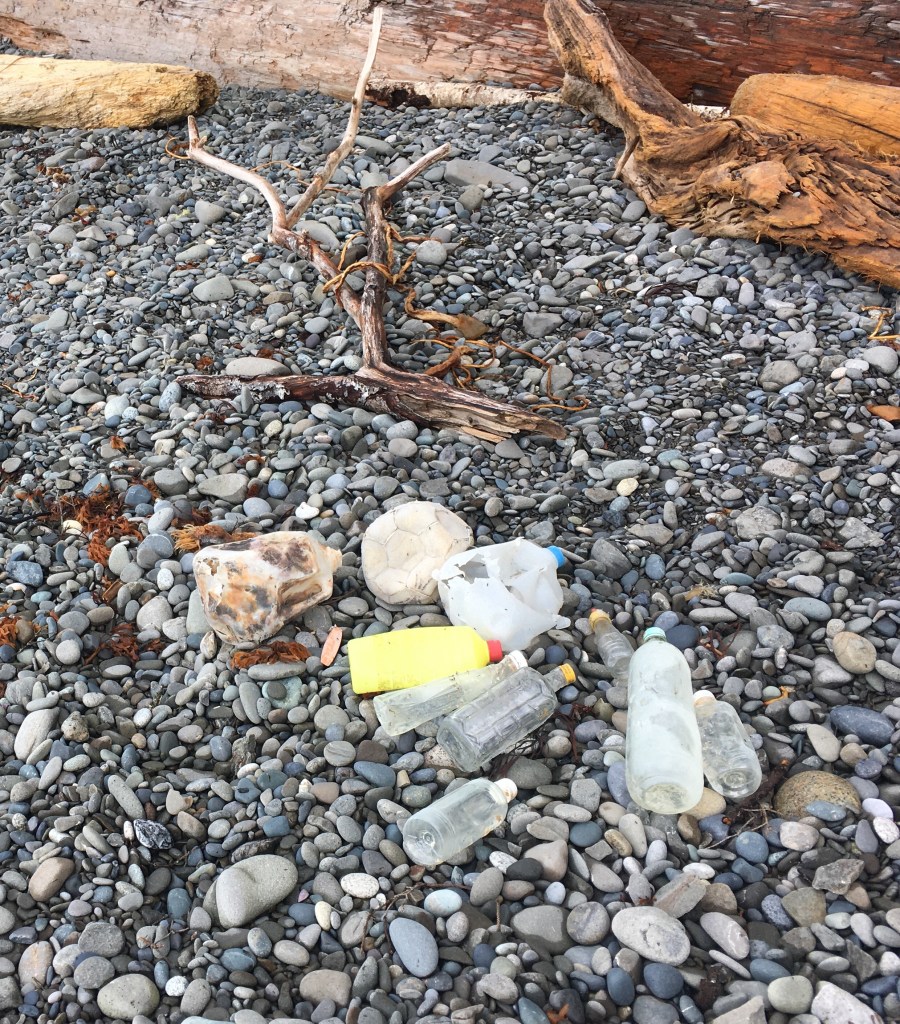
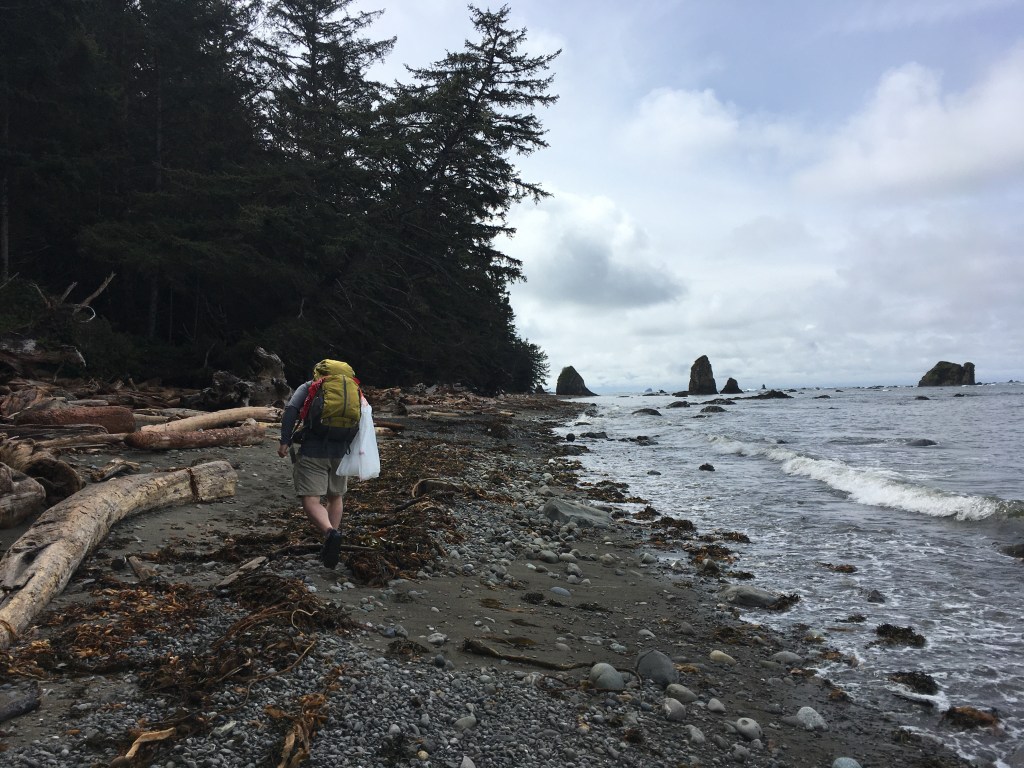
Our second day was one of jaw-dropping beauty, joy and sorrow, as we hiked three miles south along the beach, over smooth rocks in every shade of grey, the mighty Pacific crashing and calling to our right, the intermittent cries of seagulls and eagles gracing our ears, tangles of brown kelp harboring small crabs and snails beneath our feet, an endless view of saltwater studded with ancient rocky islands and brimming with life just out of sight, all beneath a sky opening slowly to blue and sunlight—-and garbage. Everywhere.
We are here for but a moment, but this is what we humans leave behind. As we walked the beach, the plastic bottles began appearing. I started picking them up, one after the other, stuffing them into my pack along with plastic caps. Large plastic floats also dotted the beach, wedged in among the logs or lying forlorn on beds of seaweed like abandoned toys. I quickly realized they were too big and numerous to carry, and with six miles to go I knew I couldn’t take them all with me. But the bottles we could carry. I wondered where they all came from—floated in from just down the road, travelled halfway across the globe or maybe even just carelessly dropped by another beach goer. It didn’t matter. All of us humans are at fault.
Josh pulled out a large garbage bag and less than two miles in we had stuffed it to the brim, along with our packs, with discarded plastic bottles and other bits of plastic. With the tide quickly rising and no more space in our bags, we trudged silently and somberly on past dozens more discarded bottles, the weight of this reality far outweighing the weight of our packs and bulging garbage sack. I imagined the miles and miles of plastic swirling out in the Pacific, lodging in the bellies of whales and sharks and a million other creatures big and small. I looked out at the ocean and silently said, “I’m sorry,”, over and over again as I stooped to pick up bottle after bottle, only to catch myself with no way to carry more.
Early on our beach hike, we came to a place called Wedding Rocks—a rocky point holding ancient petroglyphs etched by the First Peoples of this land. We stood and gazed again at these images, turned dark and rearranged by erosion and the turn of time, cast sideways and helter skelter by the shifting land. We had brought our sons here a few short summers ago, to show them this place, these wonders. We spotted the couple for which this place has been named, and the form of a ship carefully etched in the ancient rocks.
As I thought of the marks made by humans on the earth, I found myself contemplating how quickly we humans have altered, pillaged, reshaped and in many places blindly and selfishly destroyed the natural wonders of the world, causing extinctions, erosion, and irreparable damage. But we also create such beauty and marvels, in song, story and visual art such as these petroglyphs.
As the tide rose, our plastic bag bursting, and our packs heavy we approached a headland. The tide was too high to get around so we scrambled and drag our way upward over two hundred feet, with the help of a frayed plastic rope attached to the trees. From high up I could see the rugged rocks below, the ocean, the distant horizon and I made a wish.
I wished for all of us to care more. Love more. For everyone to have equal access to the wilds and wonders where the land meets the sea.
One cannot visit a place like this and not be moved. The beauty is intoxicating and hopeful and eternal. We rounded a bend and found a man ducking in naked into the ocean, his lifeguard a woman crouched onshore. Averting my eyes out of respect, we passed by and I wanted to tell him I understood. The call of the saltwater is powerful. And clothes and modesty so overrated. Suit or no suit I was happy for him.
We arrived at Sand Point a half hour later, a huge stretch of sandy beach bedecked in masses of sea kelp edged by a high ridge of beach logs. The sun came out in all its warm glory, above the crashing waves where flocks of sandpipers and shore birds danced along the water line snatching food between the grains of sand.
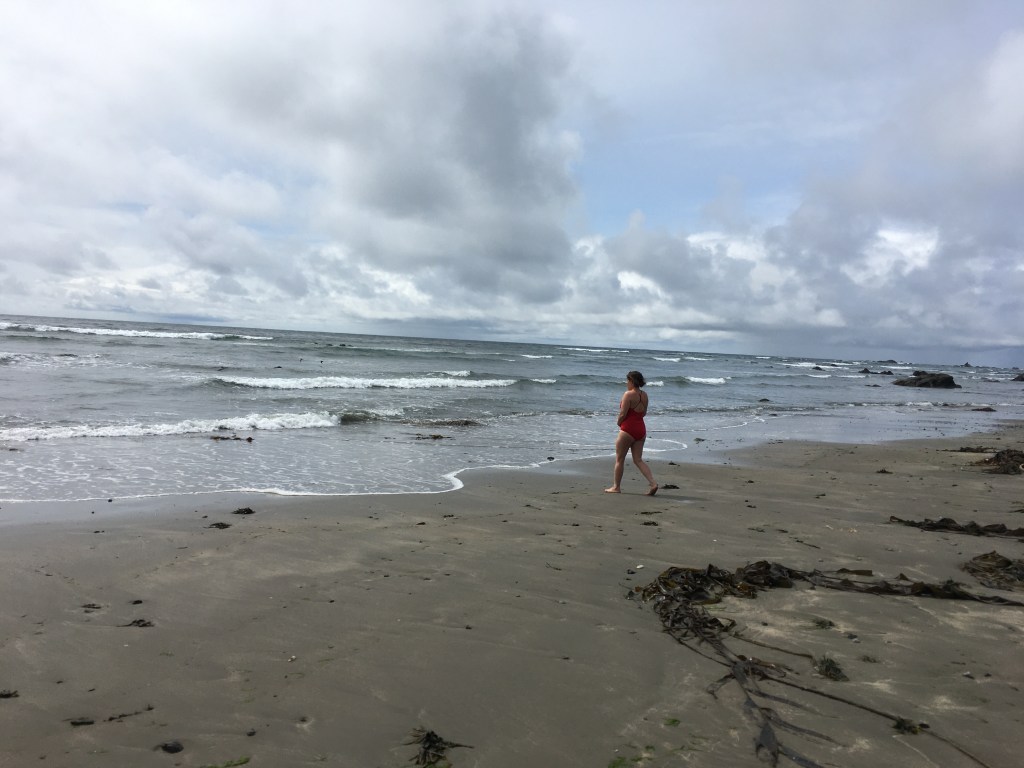
We pulled off our socks, gobbled salami and cheese with tortillas, and I prepared for a swim. Red suit on, my feet coated in warm sand, I joined the sandpipers. They parted with my arrival as I tiptoed and frolicked into the waves, imagining that I too, was one of them. Light and free and utterly fragile, and also eternal and strong and loving, like the ocean.
There were no plastic bottles nearby, to my relief, but I looked out at the water and made a promise to do better in my own ways, one bottle at a time. I made a vow to waste less, use less, buy less and reuse more. I realized that I also need to keep writing and swimming—and get outside more, and bring others with me. Perhaps my stories can also help a few people stop and think and wonder in some small new ways about how they can also make changes to save this planet.
Josh stood onshore while I moved carefully out into the shallow waters, the waves growing bigger, rocking me backwards, daring me to try.
I was very cautious. Beneath my feet I could feel pebbles and sand and large jagged rocks. This was no place to dive. We were three miles from the trail head. Not a good place to get careless and hurt.
Josh coaxed me south, where the curve grew straight, promising a more sandy bottom. I took his suggestion, found my footing over sand and pushed off, doing a shallow dive into an oncoming wave.
I popped up beaming, turned, waited for another high roller and body surfed into the shallows. Mission complete.
No—mission started, restarted, restated, stronger. The Pacific took me in, spit me out and woke me up, not unlike her younger sister, the Salish Sea.
We hiked the last three miles through the trees as rays of sunlight lit up the flora and fauna like spotlights on rock stars at a concert. I told Josh on the hike out the first day, “My eyes are so happy!” The million shades of green and brown, the shapes and angles and layers of life tumbling over each other throughout the forest like an endless waterfall.
I knew I couldn’t capture the feast before my eyes, in photo or word, to possibly do justice to the beauty we witnesssed, any more than I could possibly articulate the weight of sadness and fear I hold for our planet’s future.
And we ran out of time to be away.
We drove home to our sons, our jobs, our responsibilities, our messy house, our weedy garden and our one-eyed mutt, with a slightly different perspective and a renewed love of the wild.
Now we just need to find more ways to give back, take less, use less and pay forward all of the gifts we found at the edge of the Pacific—minus the plastic.
Seaweed blooms under a bright sun, a bath of brown flecks and pollen and happy stands of reds and greens crowd the shallows.
After we sort the barnacles beneath our tender feet, our legs jumping upwards like a dancer over hot coals we bumble awkwardly over biting stones, reaching the water’s edge at low tide. I keep my focus on the blue-green-brown water. Our destination. The place I go to breathe and let my mind and eyes wander, restore, seek and find.
The sun is hot, a freakishly warm day in April—the wetsuit feels excessive. Until we submerge.
Getting in is easy, at first. Then the cold sinks in. We’re awake!
The sea is calling me, promising an adventure, a reprieve from the dry world of hard edges and solid thoughts and stiff fingers and a burning left foot, aging…I know the water will soften me yet again and remind me that my youth lives on inside me forever.
Swimming in saltwater is what I know. Still. All these years later. The smell of salt my favorite of all smells. Better yet if it’s baked salt, heated by the sun and rising off of the sand flats brimming with mountains of seaweed and spitting clams. Heaven. At age three I went to the beach alone and stepped in to my knees, frightening my parents. And about then I also recall a trip to the ocean and the shock of being knocked down by my first big wave. Face down in sand and icy cold water, I felt my smallness then, but from that moment I think my awe of the ocean was born, a realization of it’s power over me. The crash of the waves, never ending and the limitless beauty—the vastness, the mystery of it took hold of me, never to let go.
Oh sand! What relief to our sore feet. The barnacle dance is over for now. There it is, once in and a few nervous steps out through brown fuzzy water so thick with pollen and algae I think of soup—we cannot see our feet in a foot of sea water.
Curiosity stays. This new swim feels slightly ominous, the visibility near zero, thoughts of sea lions push in. Yes, definitely too cold for jellyfish, I think. They will be here soon enough. Summer is fast approaching.
Wondering what life lurks and blooms, begins and ends, dances and dreams down here, I sink in, breathe, stroke, bubbles, breathe, stroke, bubbles. Repeat. My muscles relax, my hands stay cold while my face gets warm. Just keep watching, keep looking at the world right in front of you. My mind bubbles between clear thought, no thought, a waterfall of memories and then I return to the view of nothingness before me, a shifting palette of dull colors, flecks of brown and green, and strings of white bubbles. My own breath outwards.
I pause, and start contemplating flounder aloud,
“Maybe we will see one today!”
And Liz, “Oh no! I hope not!“
“It’s okay. They prefer the bottom, not us.”
But no, we will see no flounder today. The water stays murky and the sun is bright, and my face goes in and I dive down, and pop up through the thinnest top layer just slightly warmer, so thin I wonder if I have imagined it.
We swim south from the Pt. White pier past empty buoys in a line like lost marbles, bobbing gently over small waves. Both of us minding and not minding the muddy view. We opt to stay in the deep, visibility is so low our hands brush the bottom a few times when we drift into the shallows.
Sometimes it is better not to see what’s right below you….right?
The view is sparkling water, then a field of watery light swirling in hazy brown, the bottom no where in sight, then houses and beach and trees to the left, then water again then sun sparkles, as I take in breath right, left, right, left.
How the mind flutters and wanders out here. Should I be worrying about sea lions? How do the seals manage to not run into things when the water is so murky?
My left foot begins to ache, I let it float behind me.
We stop to gaze about, heading for the shallows again, hoping to catch site of the land below us. It is no better, dimly lit shapes appear inviting doubt. Our minds catching on the dark shadows of things we cannot identify. We head back out into deeper water, happier to not see anything but water and bands of sunlight.
We swim headlong into tall seaweed fronds bursting with pollen, or seeds or both. Whichever, the cloud bursts are impressive. Mystery solved. The cloudy water is bursting with new life and we are lucky to be here.
The blue sky above holds not a single cloud—while we swim below in water made entirely of living clouds.
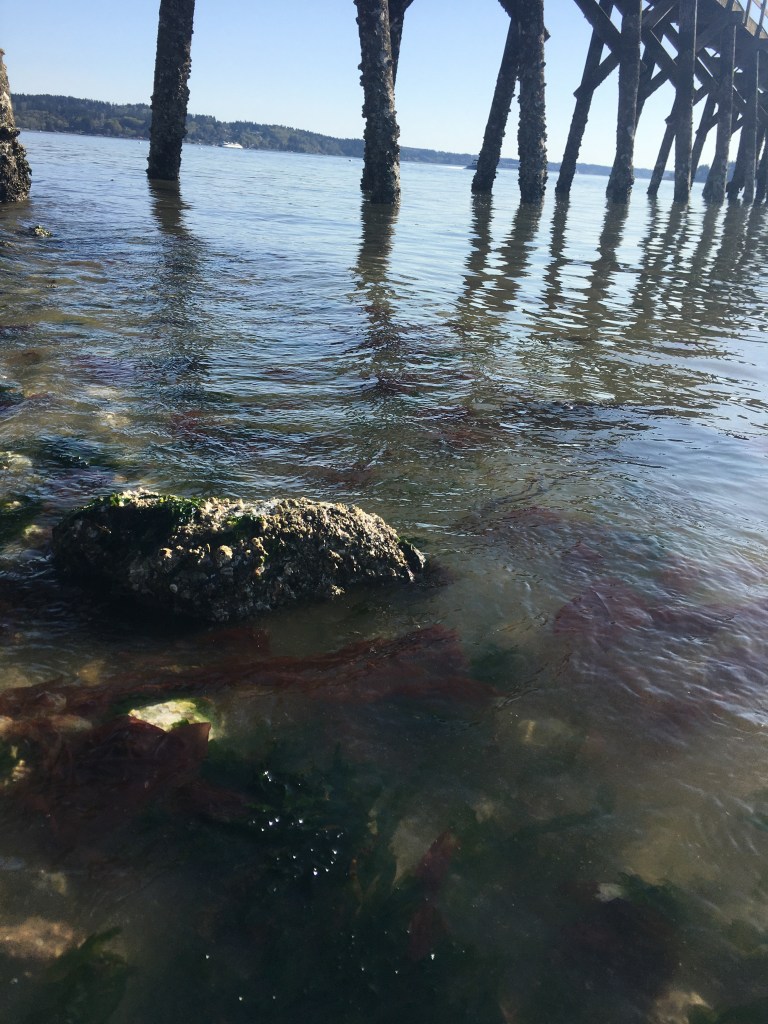
Back to the pier we swim amongst the pilings, searching for life, but only spot barnacles . My heart drops as I again find no starfish. I wonder how many decorated this pier when my father roamed these same waters as a child.
We swim north, seaweed swirls in the shallows. Boats pass by in the deep. Dogs and people stroll along the rode nearby. Birds sing. We swim.
Life. We found it.
On our final turn to shore, Liz let’s out a gleeful shout,
“Alright! Let’s do this!” a giddy call to finish what we started. A celebratory salute to what we accomplished already. The murky water be damned.
I feel awash with gratitude to be in the presence of such exuberance.
I smile.
We swim easily to shore, blissfully aglow in the gift that is the Salish Sea.
Saltwater splashes in, I cough, I pause, I look out at a sea of glistening diamonds and astounding beauty—of mountains of snow and mountains of water and whitewater and white caps —one in the same, of the same
And wind—
The waves keep crossing over and through me, my arms working to keep a steady beat, find me a space for air
I keep breathing
The next wave may be bigger, or maybe not
Nevertheless and in spite of and because I am made of water and air and light,
I will keep floating.
Floating is all I know.
The waves will keep coming, today they crash in and down around me, rocking me fiercely but easing up just enough to let me catch my breath—
So I keep breathing and look towards the light dancing across the water
It’s all I know how to do—
Breathe and float and rock through the next wave, reminding myself over and over again that to live fully is to move with the waves, and here, in the sea is a good place to practice that fine art of acceptance—
powerless to stop the waves from coming, or shape them to a size or design we think is fitting to our life we have nothing to do but ride them—
Every. Single. One.
I can hope or wish or pray or endlessly will the waves to melt away, and give me still water where I might catch my breath—but that might not be what they have in store. The next one might be a tsunami for all I know, or a mere ripple, brought on by a single rain drop.
What do I gain from imagining the worst other than living through the worst twice if it does come to pass? I could just as well imagine the best and have it come to pass and live it twice. But then the sweetness would be dulled and the magic and mystery of each shining glorious fleeting moment would be diminished.
Best to live each moment once, ride each wave fully awake and know that just as sure as it is here, it too, shall fade away —leaving only water and memory behind.
Tomorrow will come with or without me, and even were I to die tomorrow, I would float and the waves would rock me
For floating is what we do, and sometimes that is enough
To float is to breathe is to feel is to love is to swim is to rock is to hold is to be held is to protect is to dream is to live is to float
And maybe it’s all just a dream
Still, the saltwater is nice. And spring has arrived. And my feet are bare. And the water and waves keep calling me back.
Spring unfolds, the water wrapping its magic around us
Warm air, neighbor children and smiles stroll together to the beach
We anticipate delights there
The moment is now, the birds twitter in the brush, the seagulls call us to the salty brine
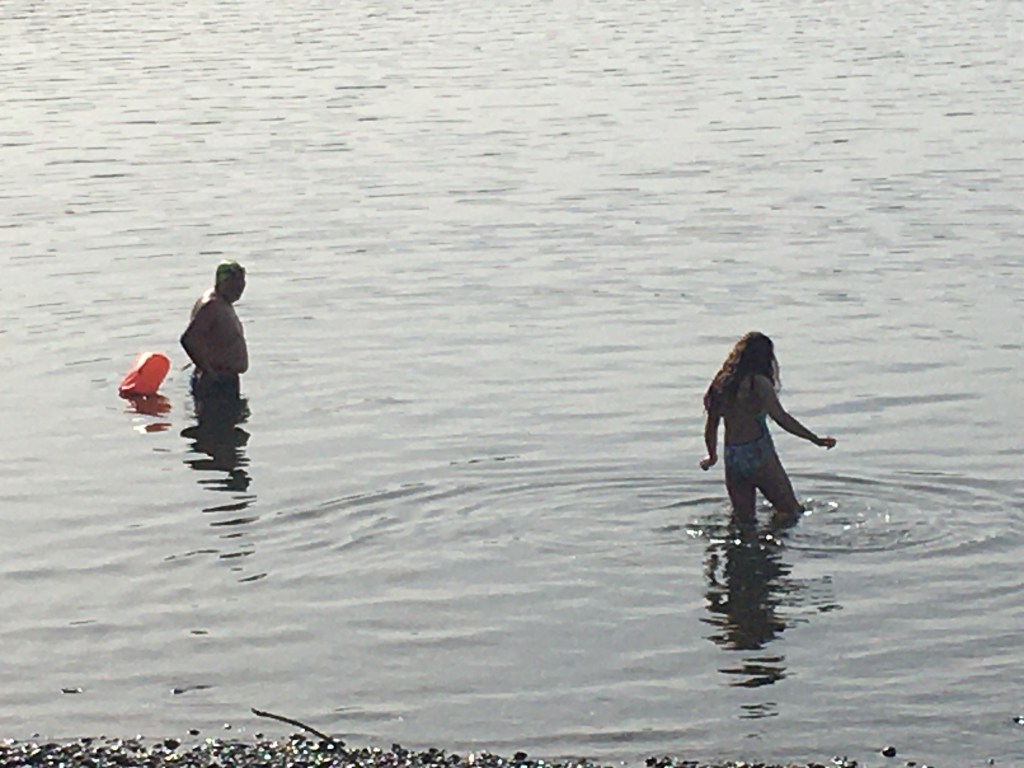
In goes young C., fearless like his father of the cold water, pleased with his own comfort he announces his method, the word “acclimatize” rolling off his tongue like a brave song, unafraid to share his many observations or his grand wonderings about his cold water dip
If only we grown-ups could hold onto that pure bliss, pure honesty, open vulnerability and desire to share freely our deepest feelings, in the moment with such grace, such optimism
Big sister M. steps in, water to bare skin like her father, boldly accepting the exquisite cold liquid with no extra layer— save a loose towel she walked the journey to the beach in swim suit, barefoot, nothing more
C. and I in our seal suits sink in, we match, we look below through watery lenses
Together our pod of four sweeps along the shallows northward, over stands of young green seaweed, where Rock and Dungeness crab larger than my hand pick at the murky treats below us
Dave lifts one by its leg, sweeping it up to dangle gently before his son to study
“Is it a male?”
Yes
With a giggle and a one finger touch, C. connects with the creature, soft skin to hard leg
One toss and the crab returns to his work below
We turn back south, M. takes to the beach to study the ancient collage beneath her bare feet, thoughtful and quiet
I reach down and raise a pair of sunglasses sitting upon brown and fuzzy rocks in the shallows
“M! I found you a treasure!” I toss them towards her. They make a small splash near her.
She lifts them, smiling
I swim easily back to the landing, feeling my body unfurl like a leaf as the still water warmed by the sun sinks in through my layers of icy winter petals —the darkness and cold melting away, floating away behind me
I beam inside, as the promise of warm months ahead sinks in
I can wait a bit longer
I can unwind my tight spring
I can let go here
Oh how I missed this unfurling, the softness the body feels when swimming warm, the ease of melting into the waters from which we all come and must someday return
At the landing we part ways, Dave ushering his children home and I continue south, beating a rhythm of joy, my body rocking through the water alone under the April sun
Bliss
And the moonsnail nests are there too
One light yellow starfish shines below, a sign of hope and stark reminder of the millions lost
One is not enough—and then I spot another. Deep purple, the size of my hand.
I swim on and wonder whether they will return, the starfish, sea stars, sun stars
I will come back here and watch for them
I will count the stars one by one
I will keep my eyes open
New life comes, always
After the winter
After the darkness
When we release ourselves and float freely, quietly upon the sea
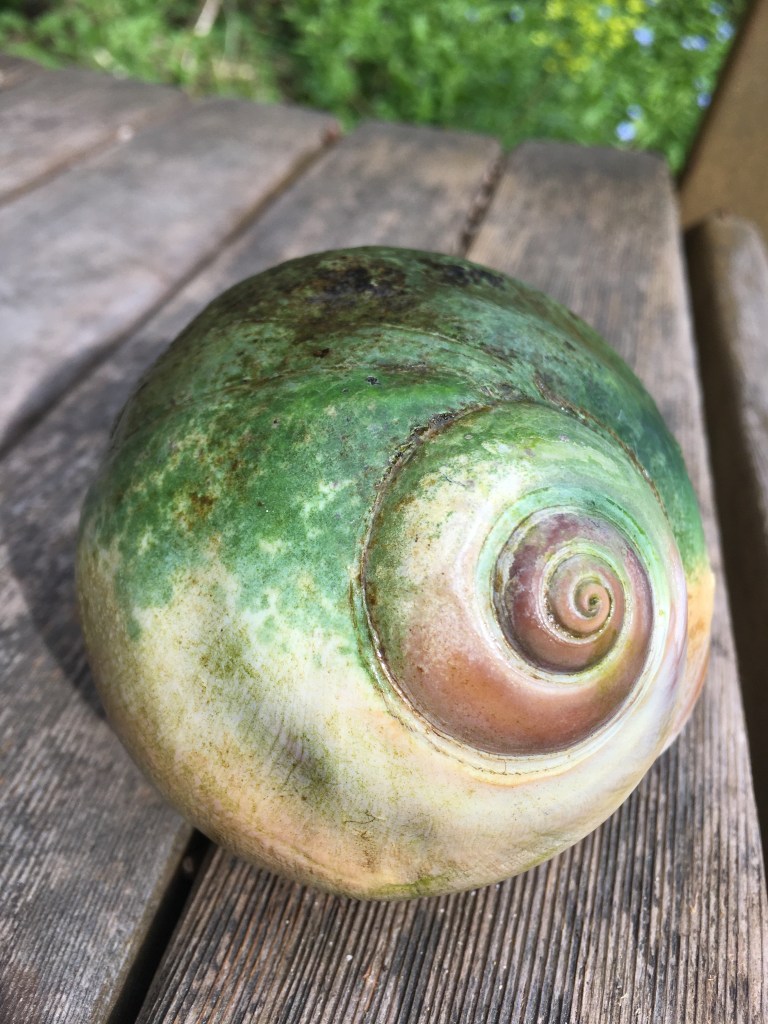
A typical adult moon snail (three species of which inhabit the Salish Sea) needs four days—plus a clam—to just reach her meal. Four entire days to drill a perfectly round hole through the clam’s hard shell, all the while fending off predators, including her own kind. Then she needs another full day to fully ingest the clam, after turning it to a liquid and inserting her specially designed moonsnail “straw” to suck out her moon-y clam soup. Time consuming and extraordinary, yes?
I have my eldest son to thank for leading me down the online rabbit hole to educate myself on these most amazing creatures, and expanding my tiniest knowledge about the sea in which I I love to swim and one of the creatures there that I find most fascinating and beautiful.
I returned from a joyful swim with Liz yesterday afternoon clutching this beautiful specimen in my cold hand when A. quizzed me on whether moon snails reuse discarded shells. He sternly suggested that I find out before claiming whole ones and possibly depriving living creatures of a good home.
I couldn’t argue. He was absolutely right.
All I knew with certainty was that hermit crabs need discarded shells to survive—live at all—as they cannot grow their own. I had no idea if moon snails did the same. I thanked him for pointing this out while I also reassured myself and him that the shells I do collect are almost all entirely missing huge sections at best or are mere fragments unable to provide a suitable home for anything requiring four walls and roof—or in this case a calcified round miracle of nature, perfectly designed and never in need of plumbing or electricity or wifi.
My research led me deeper into the world of the moon snail, and its nesting habits, of which I was intently interested. Yesterday, Liz and I headed north from the landing through happy chop with fuzzy water, and a steady southerly wind blowing warm spring air during an extremely low tide. The combination of the low tide, warmer waters and our pathway northward through the shallows revealed dozens of moon snail nests along the way. These grey collar-shaped nests sat silently on the sea floor, each one containing millions of eggs.
To build these nests and protect the eggs, a moon snail mother coats her entire foot with sand, coats the sand in mucus, laying her eggs on top and then covering the eggs with another layer of sand.
We paused to admire a nest from the depths, and I lifted it tenderly, surprised by the firmness of its form. Setting it carefully down, Liz remarked that she appreciated my comfort touching things in the water, herself more accustomed to fresh water—and not a fan of high sensory things like sea creatures. I realized in that moment how at home I feel in the saltwater. I look forward to summer, brushing up against bright green masses of seaweed and palming moon jellies in my hand with a closed finger pull through warmer waters. I told Liz how I look forward to the return of the crabs too, and small fish, starfish and the smell of salt baking in the sand and mudflats at low tide. How true that the places where you play as a child stay with you forever. You can not escape the strength of the smells and sounds and feelings formed in childhood.
The air and waves bounced us northward, past the entrance to Fletcher Bay, our frequent stops highlighted by Cheshire Cat grins and relief hovering like cherry blossoms as our bodies bobbed and danced through the waves.
I followed Liz’s lead and floated on my back, letting the water hold me, my body stretched out like a starfish, free of land and worry for a moment.
Our return trip was bumpy and slow, we were in no hurry. We came here to regroup, let go, float and connect. Before setting ashore we passed by the twin pilings west of the landing. Spider crabs tip toed around small clusters of white and brown anemones.
Time slowed down for a moment for both of us. Afterwards, we swam to shore rising up onto sharp barnacles over uneven rocks, tipsy and unsteady as toddlers as gravity took hold.
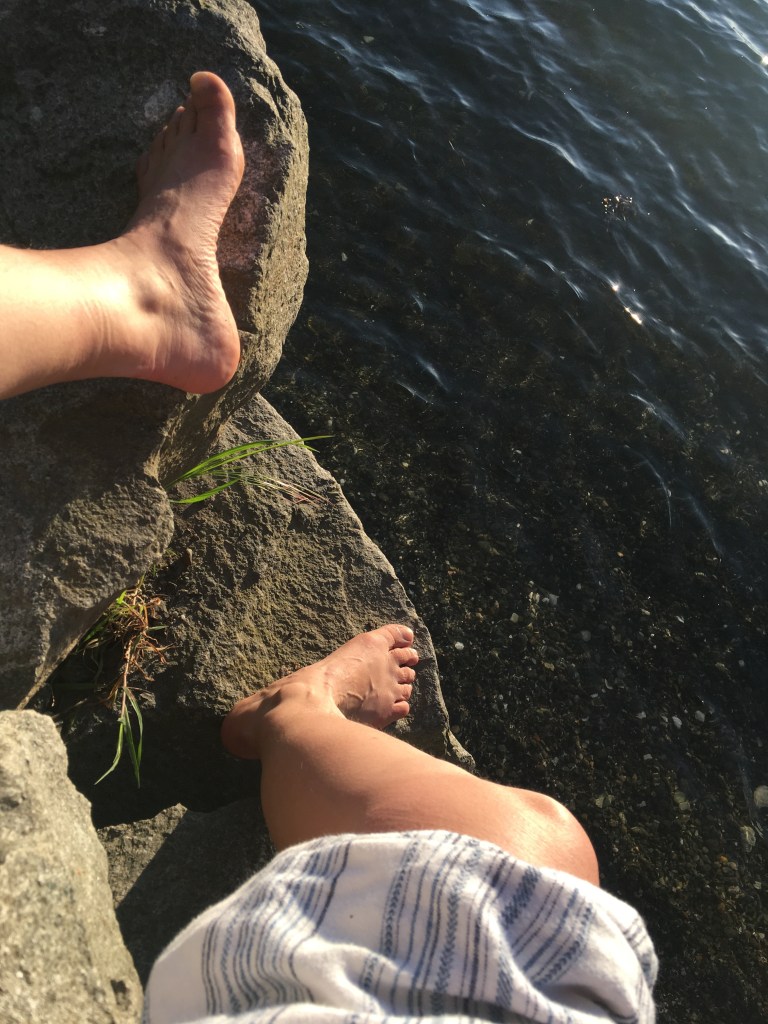
We dressed car side then sipped tea, sitting on the sun kissed beach, strewn with broken shells and pebbles. We spoke of matters big and small, savoring the after glow of a cold water swim.
Meanwhile out below the waves, millions and millions of moon snail eggs incubate, waiting to hatch when the nests break down as they ought to, and release them into the sea to claim their rightful place in the only world they will ever know.
What lucky little moon snails they will be, if only we humans can help preserve and protect the only world for all of us.
I took to the water yesterday, pushing through a wall of fatigue, unsure of myself, questioning whether the cold water would invigorate or sink me. I had returned from work to eat lunch and had collapsed onto the couch for an hour long nap. I don’t nap. Ever. Only sickness leads me to sleep during the day. When I awoke, fatigue lingered still but the sun was out and I couldn’t stop thinking about the water.
After weighing the risks and benefits of a swim, whether I was indeed getting sick or just feeling the belated effects of accumulated fatigue, I decided I might as well try. Nothing to lose but everything to gain by a cold water swim.
As soon as I pulled on my wetsuit I felt wide awake, like a veil lifted. I was made for the sea. I was made to swim. I just needed to remember this truth.
Late March beside the Salish Sea has brought very cold water, with night time temperatures dipping low enough to frost windows and leave me doubling up on sweaters for morning walks with my dog.
Tomorrow I will have made it full circle—swimming weekly through every month of the year. And yesterday felt as cold as December.
My hands recoiled at the cold and only surrendered as I offered no alternative, and my mind urged me to remember that the cold soothes my stiff fingers. Until I dove under to face early flecks of seaweed, the water fuzzy with pollen and infinitesimally small creatures did I remember that I was swimming through spring.
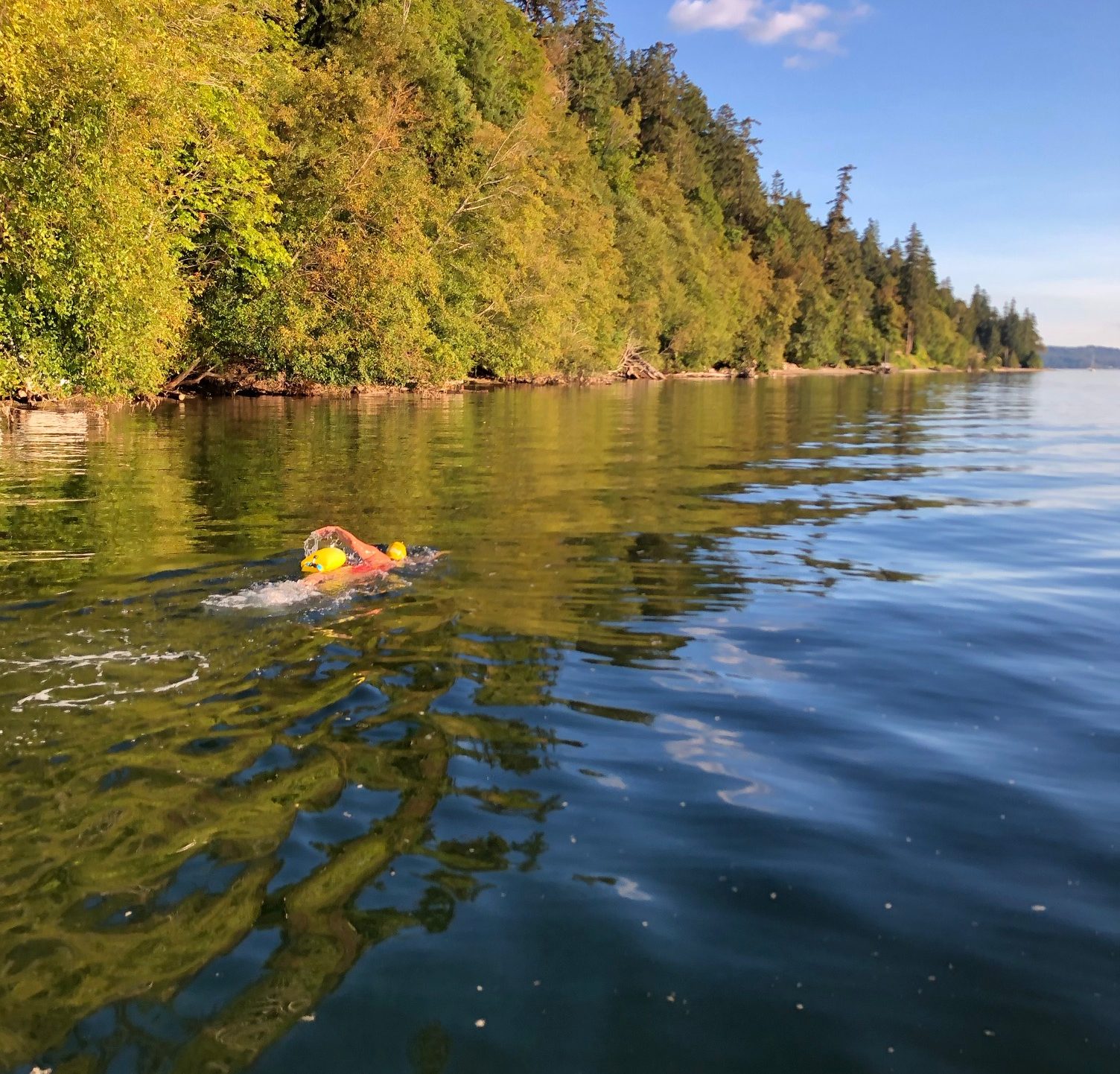
I took my familiar route south as the sun lowered and cast hazy streaks of light across my watery green horizon, bits of seaweed in browns and greens showing themselves to the light. My body fell into a calm rhythm, the strokes tied to each other like the notes of a song, carrying me forward, floating across the endless sea.
I paused to catch my breath and looked across the tiny waves —all was quiet. I was home again and my nose caught the sweet and intoxicating smell of the summer sea—joy overtook my being as I dreamt forward to low tide clam digs and piles of bright green summer seaweed, the hoisting of crab pots, lazy rowboat rides, cold beer, sleeping in tents, high mountain hikes, long warm water swims with jellyfish in just my swim suit and rollicking leaping dives off of docks with my sons, and maybe even more floating concerts with my tiny, happy band.
I turned northward and found my friends. At first I thought they were a flock of ducks or some other water birds, hoping for seals but doubtful that all of those shapes could be seals. An entire year of swimming along this shore and I only spotted one or two seals at a time.
But wait. Those weren’t birds. My eyes adjusted and I floated, intently watching their slow movements. Seals. I counted one by one, as they appeared and disappeared like dreams, in the deep, here then gone. They also were heading north, the tide pulling us all along, the highway to dinner for my perfect swim mates—a banquet of fish below—or so I hoped for them—to fill their bellies and keep them strong and happy.
My heart beat faster as I absorbed this fact—I was alone in the water with five seals. I assessed my surroundings. I was in deep water, but close enough that with five strong pulls I could be in the shallows and wade ashore. I had my bright orange buoy, a possible deterrent to the seals and I had my thick wetsuit on in the event they wanted to give me a nibble. I continued swimming, stayed my course as I continued reasoning that the seals were in search of fish, not humans, and if I just thought of them as water dogs I could relax a little and slow my heart rate. I was a mix of fear and excitement, thrilled to have company and equally anxious and longing to find one swim close enough below me to catch site of their exquisite torpedo-shaped bodies, dappled with polka dots and broken light from the sunlight cutting through the surface.
From time to time I’d pause to peer back at them, watching their speedy progress northward, in awe of their speed through their watery home. I longed to glide through this watery world with that grace—they moved perfectly with the water. Of the water.
My heartbeat settled as I reached the road end. For a moment I longed to turn seal, not feel the cold, dive for hours and days, live the water life. Swim like a wave, of the water. Bound to the tides, the currents, the migrations of the fish, the mysteries below.
Back onshore I hauled my clothes down to the sunny bench to dress and watch the water. With my glasses back on, I pulled on my socks over frozen toes and started counting. Twelve? Fourteen seal heads out beyond the pilings. Out of the corner of my eye a large splash, then the familiar bark.
The feasting was underway. I sat marveling at this wonder of bodies dancing in the evening light, the world spinning all the while around the sun.
That light that falls upon us everyday but we forget it is there
Blinded by the darkness we look forward and backward forgetting that we are the light
Each one of us is the light
We are made of water and light
What else do we need to know?
Yesterday I swam in cold water, buried in dark thoughts, anger, disappointment, fear, shocked by death’s hold on all of us
I glided, bubbles rising by my two lungs, over delicate grey moon snail nests while cold salt water nestled in close to my heart
I forgot to float, caught up in thoughts so scattered that even swimming could not set them free, but to the bottom I’d have gone if not by the wonder of my arms and legs and beating heart pulling me along, my mind a float buoy detached
Only time and rain and sunlight and the beauty of today, a house full of my loves, my husband, my sons, my niece, my sister, and a bake well tart carefully formed with old and young hands that waited a year for this moment —brought me back to the sea, and all that I missed
Here I found the water again
Here I felt the light of love
And though today is tonight is tomorrow is yesterday I know the light will keep pushing through
Light always get through
And the water will hold me even when I cannot see it or touch it







 Mary Swims